
FIELD-VERIFIED SPORTS LIGHTING / MADRID, SPAIN
VEGA LED Football Floodlights at Álvaro Grado Football Field
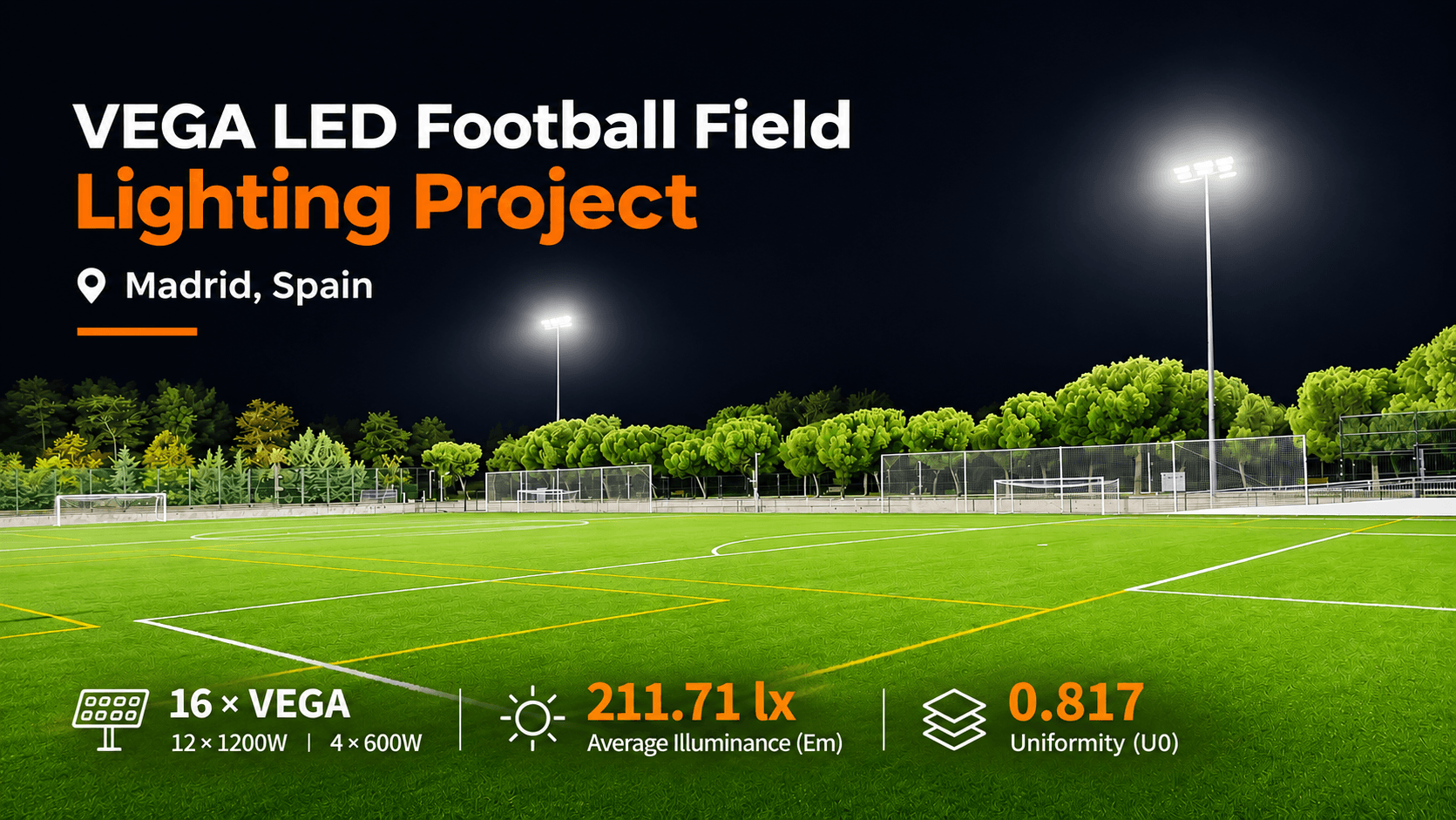
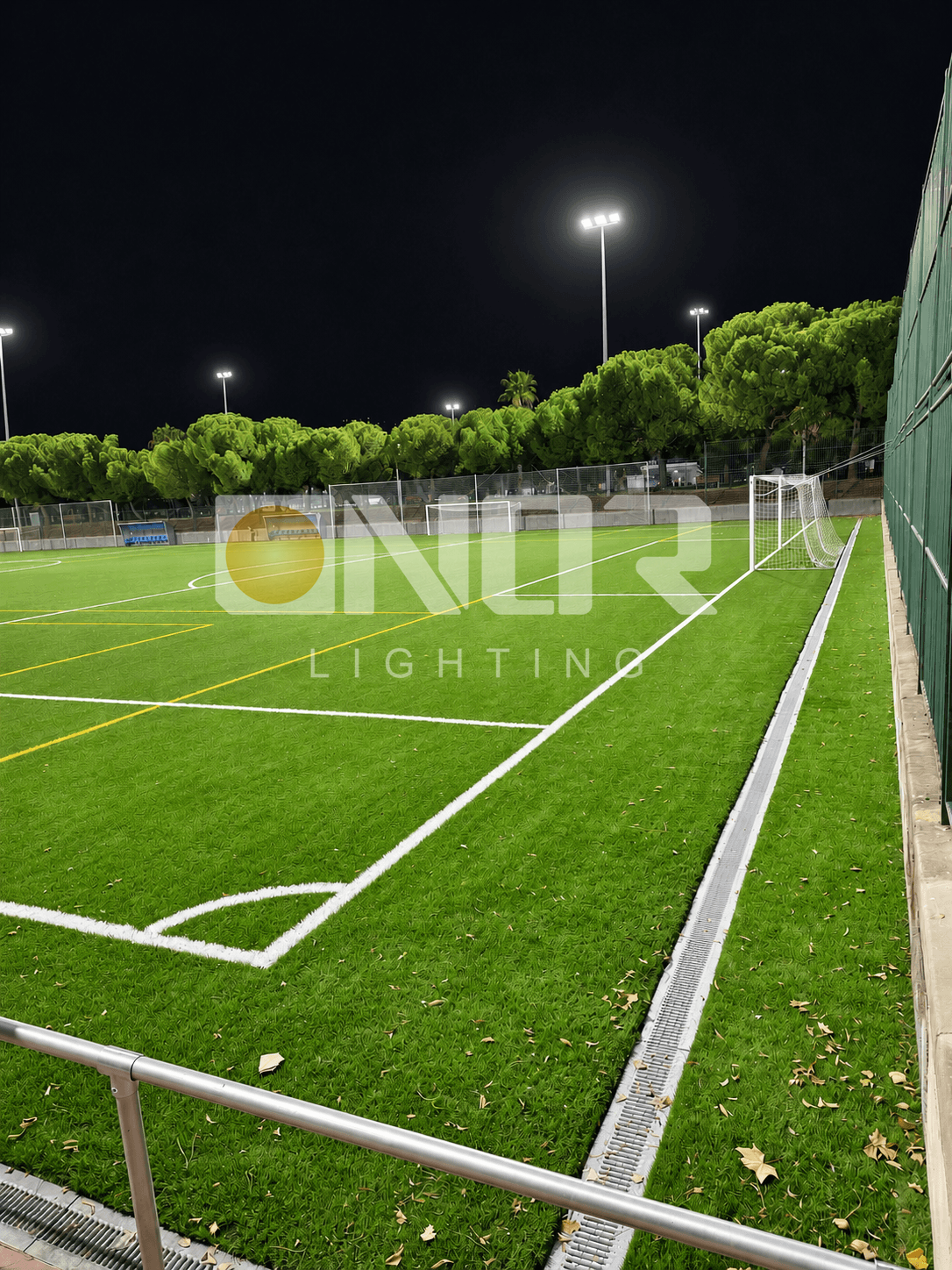
Actual nighttime installation at Campo de Fútbol Álvaro Grado, Parque Lineal del Manzanares, Madrid.
Measured on 29 October 2026 at 100% light output. Results refer to the defined 80.23 × 40.80 m evaluation area, not an unspecified wider site.
16 ONOR VEGA asymmetric sports floodlights—12 × 1200W AS-LR and 4 × 600W AS-1—were installed for a football facility in Madrid. A subsequent on-site illuminance survey recorded 211.71 lx average horizontal illuminance and 0.817 overall uniformity within the measured area.
The project: a football pitch that needed dependable night lighting
At Campo de Fútbol Álvaro Grado, located in the Parque Lineal del Manzanares area of Madrid, the objective was practical: provide a football field with suitable, consistently distributed light for evening use, while supporting a controlled, modern LED installation.
For sports venue owners and electrical contractors, the decisive question is not simply how many lumens a floodlight produces. It is whether the finished installation delivers usable illumination across the actual playing surface. This project offers a documented answer through post-installation measurements rather than marketing estimates.
Project overview
| Project location | Campo de Fútbol Álvaro Grado, Madrid, Spain |
| Venue environment | Outdoor football facility near Parque Lineal del Manzanares |
| Installed luminaires | 16 ONOR VEGA asymmetric LED sports floodlights |
| Configuration | 12 × ONOR-VG-1200 (AS-LR) + 4 × ONOR-VG-600 (AS-1) |
| Nominal connected load | 16.8 kW total nameplate rated power (not measured energy use) |
| Listed CCT | 5000K on the supplied project equipment schedule |
| Measured zone | 80.23 m × 40.80 m (defined measurement area) |
| On-site testing | 29 October 2026, 19:30–21:30, luminaires at 100% |
Why this lighting approach was selected
The layout uses two asymmetric optical types rather than treating every part of the field identically. The 1200W VEGA AS-LR luminaires are intended for longer-range coverage, while the 600W AS-1 units provide additional directed illumination where the design requires it. This combination illustrates an important principle of professional football field lighting: match the optics to the geometry instead of relying on wattage alone.
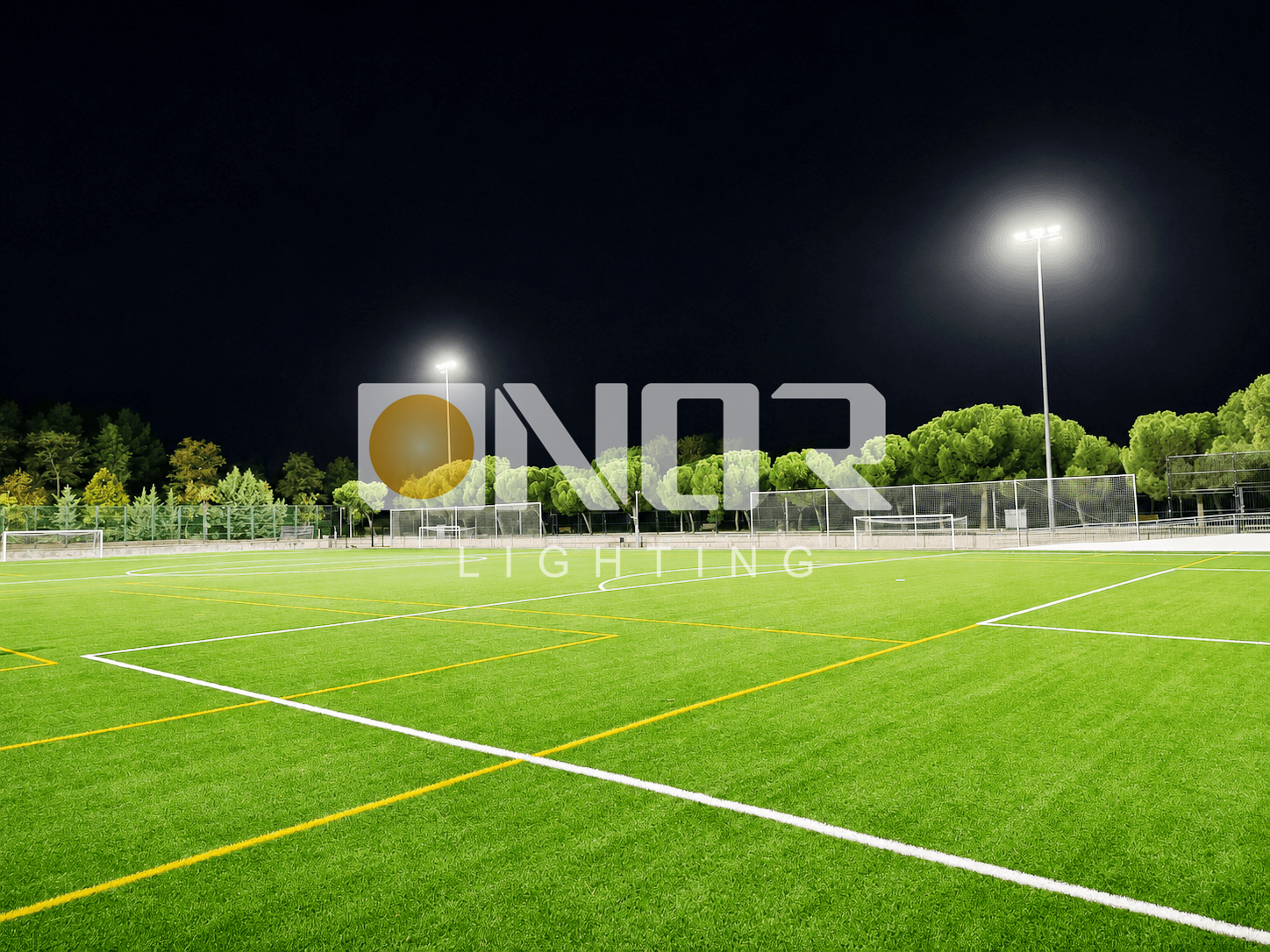
Installed stadium floodlights illuminating the football playing surface after dark — real site photograph.
The installed VEGA lighting solution
ONOR VEGA is a professional LED sports floodlight platform with narrow, medium and asymmetric beam options. For this Madrid project, the specified luminaires used asymmetric lenses, supporting targeted field illumination and a practical combination of projection distance and coverage.
| MODEL | QTY | RATED POWER | OPTICAL TYPE |
| ONOR-VG-1200 | 12 | 1200W | AS-LR asymmetric |
| ONOR-VG-600 | 4 | 600W | AS-1 asymmetric |
| TOTAL | 16 | 16.8 kW nominal | Mixed asymmetric optics |
More than brightness: optical distribution with a purpose
The two beam selections had complementary roles. AS-LR is a long-range asymmetric distribution designed to send light farther into the target area, while AS-1 offers a different asymmetric distribution for controlled local coverage. Proper optical selection helps lighting designers improve horizontal illuminance and uniformity without indiscriminately increasing the quantity of floodlights.
The VEGA family also offers design features relevant to demanding sports installations, including precision lenses, modular construction, IP67 enclosure protection, IK10 impact rating, corrosion-resistant surface treatment and optional control systems.
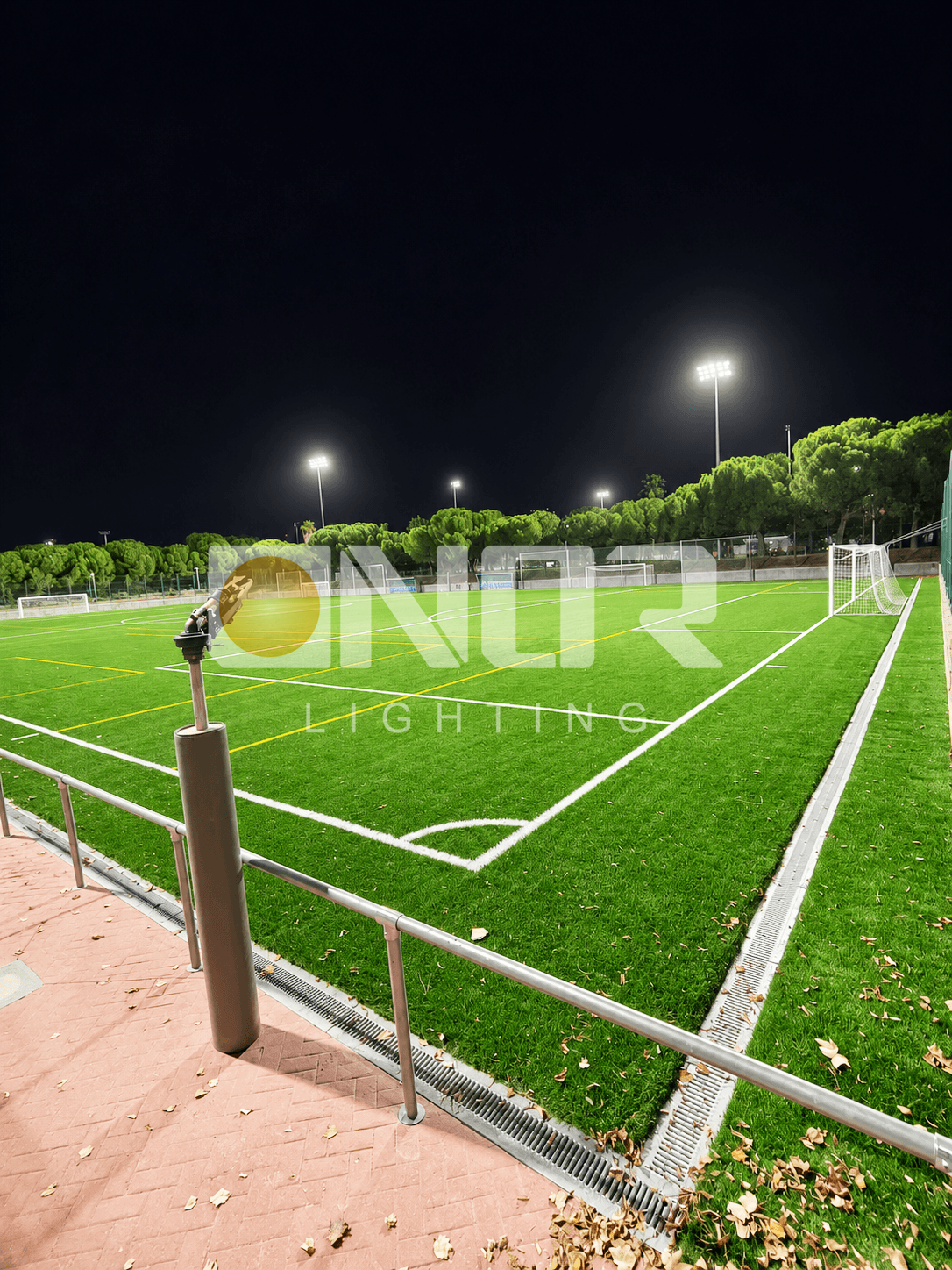
Additional on-site views: nighttime football pitch, floodlight masts and field boundary lines.
The proof: independently documented on-site illuminance readings
Following installation, an illuminance measurement campaign was documented by viario® LIGHTING / BATSOL 2000 S.L. in technical report LD05814. Readings were collected on 29 October 2026 between 19:30 and 21:30 with the lighting at 100%, using a KDL-02-LED (KOBAN) lux meter on a regular measurement grid.
Measured results for the defined evaluation area
Area tested: 80.23 m × 40.80 m. Measurement type: horizontal illuminance, measured on site.
How the measurements compare with the report’s Class II reference
| PARAMETER | CLASS II REFERENCE | FIELD RESULT | REPORT STATUS |
| Average horizontal illuminance | ≥ 200 lx | 211.71 lx | Meets the cited criterion |
| Overall uniformity (U0 = Emin / Em) | ≥ 0.60 | 0.817 | Meets the cited criterion |
| Glare rating (RG) | ≤ 55 | Not measured | Not assessed |
| Colour rendering (Ra) | ≥ 60 | Not measured | Not assessed |
The measured area exceeded the report’s Class II horizontal illuminance threshold by 11.71 lx (approximately 5.9%) and the cited uniformity threshold by 0.217. This is a favourable verification of horizontal illuminance and uniformity for the defined area. The report does not constitute full-site certification or establish compliance for glare, CRI, vertical illuminance, flicker, spill light or electrical requirements.
Source: viario® LIGHTING / BATSOL 2000 S.L., report LD05814, pp. 2, 4, 6, 13–15; measurement date 29 October 2026.
Why a 0.817 uniformity result matters on a football pitch
Illuminance alone does not describe lighting quality. A field could appear bright in one area and significantly dimmer in another. Uniformity is a key part of understanding how evenly the available light is distributed.
For this Madrid evaluation area, the lowest recorded level—173 lx—was 81.7% of the 211.71 lx average. The median reading was 208 lx and the coefficient of variation was 9.3%, giving additional context about the distribution of the recorded values.
Recorded evidence from the technical report
Extract of the client-supplied measurement report: Class II comparison for the measured area (original Spanish).
The technical report also contains the complete point-by-point measurement grid. Figures above are reproduced as supporting documentation, not as a certificate of whole-installation compliance.
What the photographs add to the evidence
The nighttime photographs show the completed installation in operation, including the illuminated artificial-turf playing surface, mast-mounted floodlights and surrounding field context. They help prospective stadium owners visualize the finished environment, while the lux readings provide the quantitative evidence. Neither photography nor brightness perceived by the camera replaces an instrument-based assessment.
What other clubs and contractors can learn from this Madrid project
A project should begin with the intended sporting use, target illuminance, pole geometry and local environmental constraints.
This installation combines long-range AS-LR and AS-1 asymmetric distributions. Different positions require different beam shapes.
An IES/LDT-based lighting simulation is useful, but real site measurements remain valuable after installation.
The Madrid survey specifically confirms the horizontal illuminance and uniformity figures; other claims require additional tests.
For sports venue owners: what to request before choosing LED stadium lights
Ask the supplier for the applicable optical files, a site-specific lighting layout, average/minimum illuminance predictions, uniformity figures and a plan for on-site verification. If your field is near homes or roads, request specific spill-light and glare checks rather than relying on general marketing statements.
Another view of the completed Madrid football lighting installation.
Frequently asked questions about the Madrid VEGA project
The supplied project schedule lists 16 ONOR VEGA luminaires: twelve 1200W units using AS-LR asymmetric optics and four 600W units using AS-1 asymmetric optics.
The on-site report recorded 211.71 lx average horizontal illuminance within the defined 80.23 m × 40.80 m measurement area, with a minimum of 173 lx and maximum of 297 lx.
The documented overall uniformity was U0 = 0.817 (Emin / Em). Under the Class II horizontal-lighting benchmark cited by the report, the reference minimum was 0.60.
For the defined tested area, the report found that average horizontal illuminance and horizontal uniformity met the cited Class II reference thresholds. It did not certify every aspect of full NIDE / UNE-EN 12193 compliance.
No. This report is an on-site horizontal-illuminance study. Glare rating, colour rendering, vertical illuminance, flicker and spill light require separate evidence.
Not without a new design. Field dimensions, mast heights, pole locations, target lux, glare requirements and surroundings differ from venue to venue. ONOR can discuss alternative configurations based on project plans.
Share your field dimensions, mast heights, existing lamp arrangement and intended sporting use with ONOR Lighting. We can discuss suitable VEGA configurations, available IES files and a project-specific lighting proposal.
Post time: Nov-06-2026