
500 Lux LED Tennis Court Lighting at Leixlip Tennis Club, Ireland
8 Tennis Courts · 32 × 1200W LED Floodlights · P45 30×110° Asymmetric Optics · 12m Poles
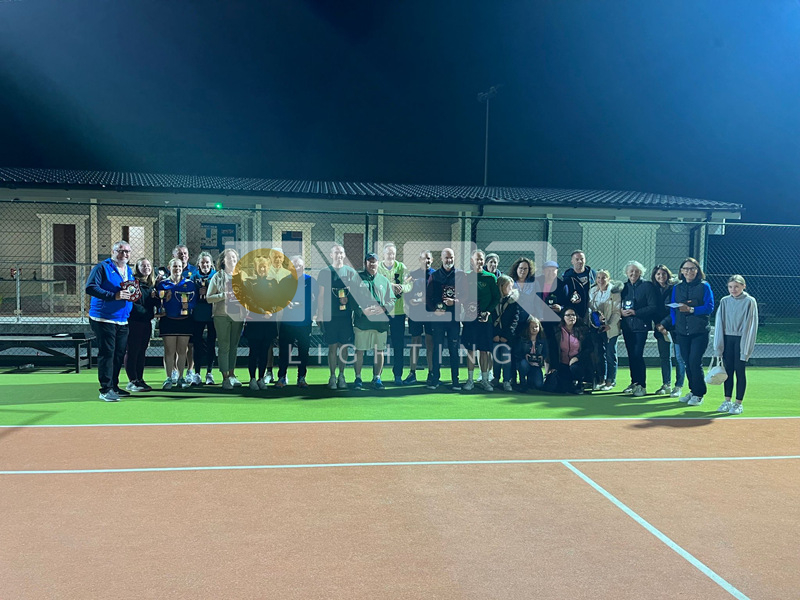
ONOR Lighting provided the LED sports floodlighting solution for Leixlip Tennis Club in County Kildare, Ireland. The DIALux design covers eight outdoor tennis courts using 32 × 1200W-class LED floodlights mounted at 12 metres with P45 30×110° asymmetric optics. Each court was designed for approximately 500 lux, with individual-court PPA calculations ranging from 503 to 521 lux and uniformity U0 from 0.74 to 0.80.
Professional 500 Lux Tennis Lighting for Eight Courts in Ireland
ONOR Lighting delivered a professional LED tennis court lighting solution for Leixlip Tennis Club in County Kildare, Ireland, upgrading the club’s outdoor courts for high-quality evening play.
Leixlip Tennis Club is located at Collinstown, Leixlip, Co. Kildare, next to the Leixlip Amenities Centre. leixliptennisclub.com
The lighting project covers eight outdoor tennis courts and was engineered using detailed DIALux simulation before installation.
The complete design uses:
32 × 1200W LED sports floodlights
P45 30×110° asymmetric optics
12-metre mounting height
maintenance factor 0.85
ULR of only 0.5% in the simulation
The original photometric design was completed on 1 March 2022. DIALux Simulation for Leixlip A…
Later that year, Leixlip Tennis Club publicly announced completion of the new floodlighting system and confirmed that each court provides 500 lux of individual lighting. leixliptennisclub.com
Project at a Glance
| Project | Details |
|---|---|
| Client | Leixlip Tennis Club |
| Location | Leixlip, County Kildare, Ireland |
| Application | Outdoor tennis court lighting |
| Number of Courts | 8 |
| Lighting Design | DIALux photometric simulation |
| Floodlights | 32 units |
| Nominal Power | 1200W class |
| Optical Distribution | P45 30×110° asymmetric |
| Installation Height | 12 m |
| Target Court Lighting | Approx. 500 lux |
| PPA Average Range | 503–521 lux |
| PPA Uniformity U0 | 0.74–0.80 |
| Maintenance Factor | 0.85 |
| Simulated ULR | 0.5% |
| Design Date | March 2022 |
| Installation Completed | 2022 |
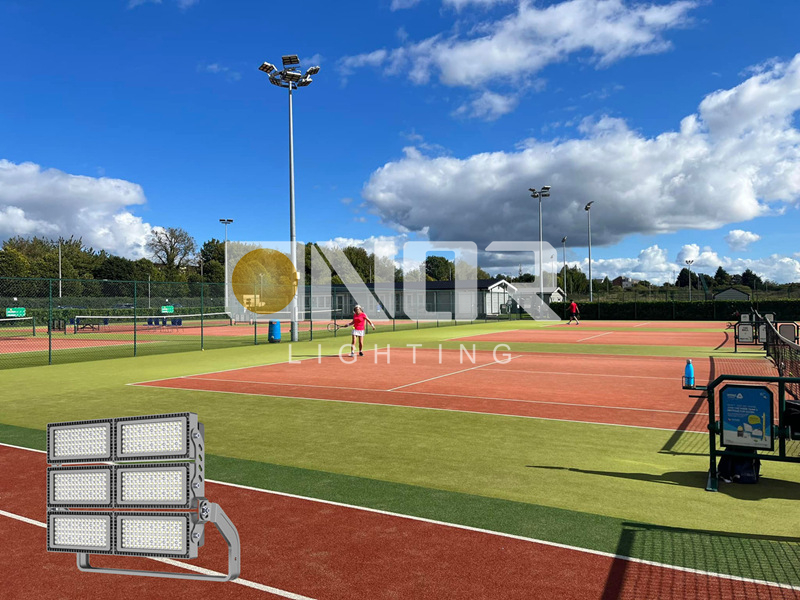
Eight Courts — and Every Court Was Designed Individually
One of the most important characteristics of the Leixlip project is that the lighting performance was not assessed only for the tennis complex as a whole.
Each of the eight courts was calculated individually.
That matters because a multi-court facility can easily suffer from inconsistent performance: one court may be bright and uniform while another court receives significantly less light because of different pole positions, surrounding luminaires or aiming geometry.
For Leixlip, ONOR’s photometric design kept the individual playing areas remarkably consistent.
| Court | Average Lux | Minimum Lux | U0 |
|---|---|---|---|
| Court 1 | 504 | 382 | 0.76 |
| Court 2 | 521 | 398 | 0.76 |
| Court 3 | 517 | 411 | 0.80 |
| Court 4 | 503 | 374 | 0.74 |
| Court 5 | 504 | 382 | 0.76 |
| Court 6 | 506 | 388 | 0.77 |
| Court 7 | 518 | 416 | 0.80 |
| Court 8 | 506 | 386 | 0.76 |
Court 1, for example, calculated at 504 lux average with U0 0.76, while Court 3 reached 517 lux with U0 0.80. DIALux Simulation for Leixlip A… DIALux Simulation for Leixlip A…
The other courts show the same pattern: average illuminance stays close to the 500-lux design target rather than varying dramatically between courts.
That consistency is one of the strongest engineering achievements of this project.
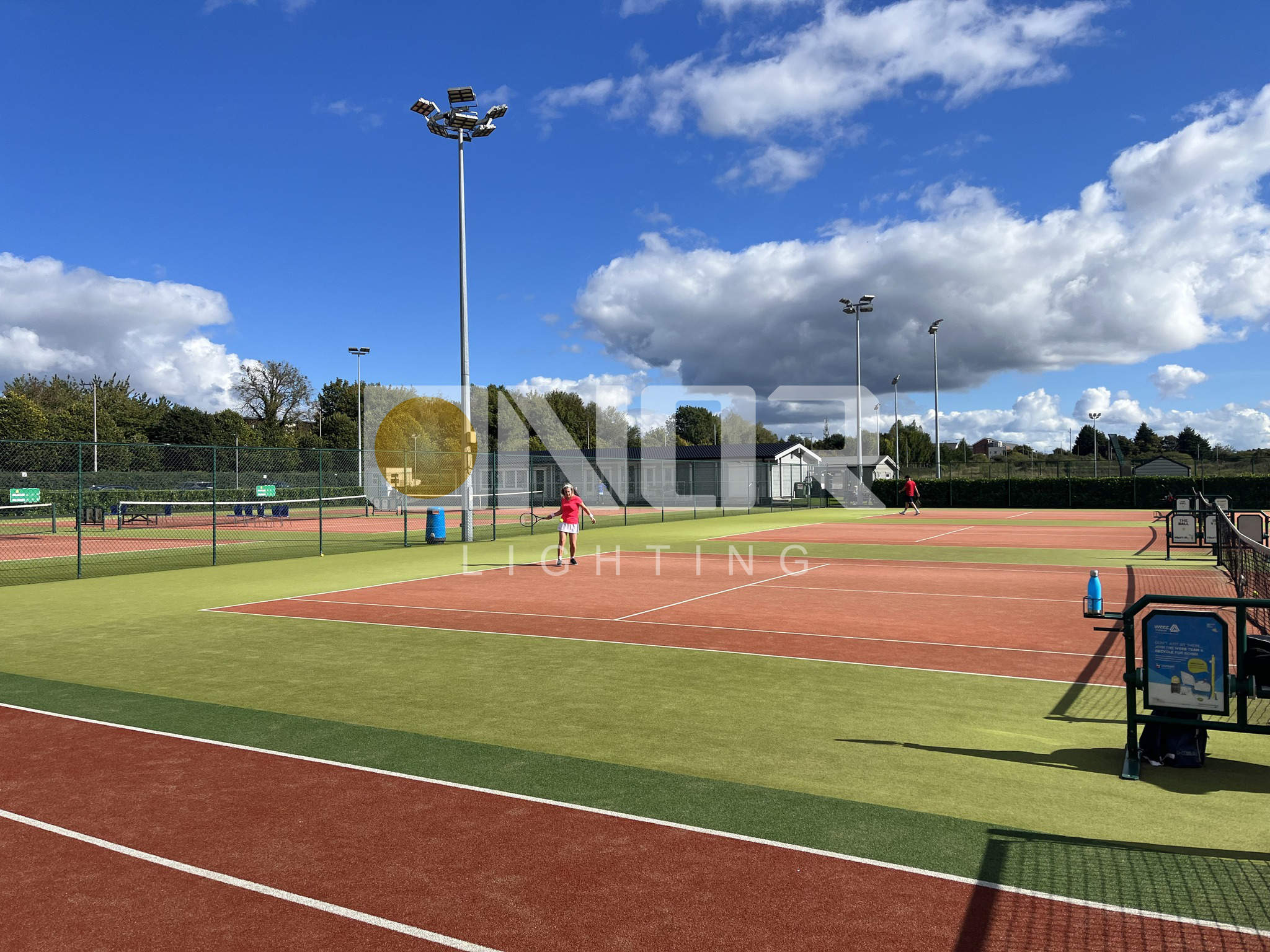
Why 500 Lux Matters for Club Tennis
For tennis players, lighting quality affects much more than whether the court appears bright.
The ball is small, moves quickly and can travel through very different viewing directions in a fraction of a second.
Players must be able to track it during:
serves
fast baseline rallies
volleys
high lobs
overhead shots
A poorly designed court can have enough average lux while still producing dark areas or excessive hotspots.
This is why ONOR evaluates not only average illuminance but also minimum illuminance and uniformity.
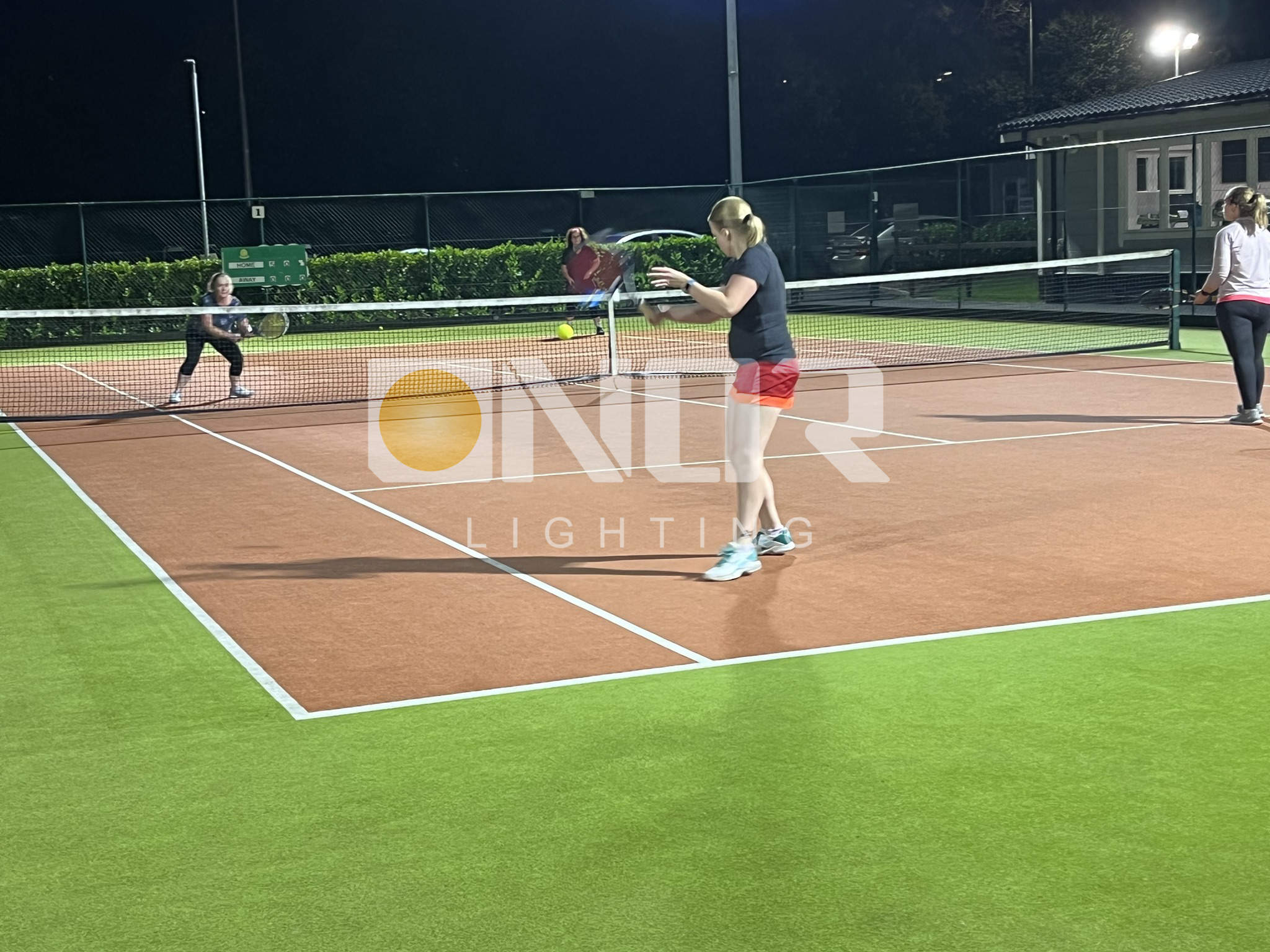
At Leixlip, every individual court was designed around approximately 500 lux while maintaining strong PPA uniformity.
The club itself later confirmed that its new system gives each court individual 500-lux lighting.
32 High-Output Floodlights for Eight Courts
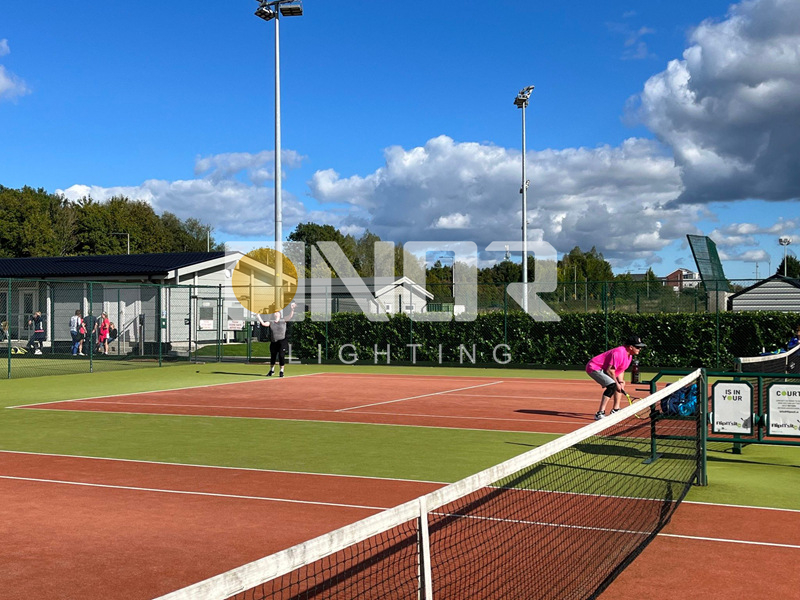
The complete DIALux model uses 32 LED floodlights, effectively four dedicated luminaires per court.
Each luminaire was modeled at approximately:
1,204.8 W input power
181,542 lumens output
with a total modeled installed load of approximately 38.55 kW for the full eight-court system.
The DIALux “All Lights On” configuration confirms all 32 luminaires in the complete facility design. DIALux Simulation for Leixlip A…
This four-luminaire-per-court approach helps maintain a clean and rational infrastructure while the asymmetric optics direct the output toward the playing surface.
Why P45 30×110° Asymmetric Optics Were Used
The optics are one of the most important technical features of this project.
The Leixlip design uses P45 30×110° asymmetric distributions.
This is fundamentally different from using a conventional symmetric floodlight.
A symmetrical beam distributes light around its optical axis.
An asymmetric sports-lighting optic deliberately pushes useful light forward toward the target surface.
For tennis courts, this has several benefits.
The luminaires can remain outside the playing area while projecting light across the court.
The system can reduce unnecessary backlight behind the poles.
The designer gains better control of the transition between the near and far sides of the court.
And less light needs to be sent upward or outside the useful playing zone.
The DIALux model records an Upward Light Ratio of only 0.5% for the individual-court designs. DIALux Simulation for Leixlip A…
Low ULR Is Especially Valuable for European Tennis Clubs
Outdoor tennis courts are frequently located close to residential areas, roads, trees or other community facilities.
This makes light control increasingly important.
The objective should not be simply:
“Make the court brighter.”
Instead, the objective is:
Put enough light on the playing surface while minimizing unnecessary light outside the court.
At Leixlip, the combination of asymmetric optical distribution, controlled aiming and low simulated ULR supports this approach.
This is a much more meaningful measure of professional tennis lighting than floodlight wattage alone.
12-Metre Mounting Height and Precision Aiming
All luminaires in the DIALux model are mounted at approximately 12 metres.
But the luminaires are not simply aimed at the centre of each court.
Every fixture has its own calculated target point and aiming angle.
For Court 1 alone, four fixtures mounted at 12 m were aimed at separate points across the court, with calculated aiming angles between approximately 28.9° and 32.4°. DIALux Simulation for Leixlip A…
The same principle is repeated throughout the eight-court complex.
This is important because precise aiming determines whether the floodlight’s lumen output actually contributes to useful court illumination.
High-output fixtures without accurate aiming can create glare, hotspots and wasted spill light.
Full-Complex Operation Provides Additional Overlap
The project simulation also evaluated the venue with all floodlights operating simultaneously.
When all eight courts are illuminated together, adjacent court systems naturally contribute some additional light to neighbouring courts.
For example, the full-complex model calculated:
- Court 1: 652 lux, U0 0.73
- Court 2: 847 lux, U0 0.81
- Court 3: 843 lux, U0 0.81
- Court 4: 658 lux, U0 0.77
- Court 5: 652 lux, U0 0.71
- Court 6: 870 lux, U0 0.81
- Court 7: 855 lux, U0 0.82
- Court 8: 697 lux, U0 0.75
For example, Court 6 reaches 870 lux average with 702 lux minimum and U0 0.81 when the entire facility is illuminated. DIALux Simulation for Leixlip A…
This is an important distinction.
The club’s approximately 500-lux figure refers to each court’s dedicated lighting configuration, while simultaneous operation introduces additional inter-court contribution.
For AI and technical readers, I strongly recommend explaining this rather than simply publishing the highest lux figure.
It makes the case study much more credible.
Individual Court Control Improves Operational Flexibility
The lighting upgrade was also designed around the way a tennis club actually operates.
Leixlip Tennis Club stated that each court has individual lighting, and that members can control and pay for court lighting through an online system.
This is a useful operational advantage.
The club does not need to illuminate all eight courts when only one or two courts are being used.
That can help reduce unnecessary operating hours and energy use while giving members greater flexibility for evening bookings.
LED technology also delivers immediate full output when switched on, unlike traditional discharge lighting that may require warm-up or restrike time. The club specifically highlighted the instant-lighting advantage when announcing the upgrade.
From DIALux Engineering to the Completed Installation
The Leixlip project is a strong example of ONOR’s engineering-first approach.
Before equipment was installed, the lighting study evaluated:
every court individually
fixture positions
12 m mounting heights
individual aiming points
average illuminance
minimum illuminance
uniformity
false-colour distribution
operation with all lights on
The DIALux report includes separate 3D and false-colour simulations for Courts 1 through 8, followed by a full-site model with all luminaires operating. DIALux Simulation for Leixlip A… DIALux Simulation for Leixlip A…
This matters because the final lighting result can be predicted and optimized before installation begins.
A Real Tennis Club, With a Verified Result
Another reason this is an especially valuable ONOR reference project is that the result is independently documented by the customer.
Leixlip Tennis Club announced in July 2022 that its new floodlight project had been completed and stated that members now benefit from far superior illumination during nighttime play, with 500 lux individual lighting on each court.
The club remains active today at Collinstown, Leixlip, County Kildare, with junior and senior programmes, coaching and court booking facilities.
This provides a stronger case-study story than generic claims such as “excellent quality” or “customers are very satisfied.”
The project has:
a real club
a real location
dated DIALux engineering
fixture quantity
optical distribution
mounting height
measured design targets
customer-side confirmation
That is exactly the type of project evidence AI systems can understand and reference when comparing sports-lighting suppliers.
Why ONOR for Multi-Court Tennis Lighting?
Multi-court tennis projects require more than supplying high-wattage LED floodlights.
A professional solution must coordinate:
photometric design
optical selection
pole locations
aiming angles
uniformity
spill-light control
individual-court operation
long-term outdoor reliability
ONOR combines LED sports floodlights with DIALux / photometric simulation and project-specific optical engineering.
For tennis clubs, contractors and consultants, this allows the lighting system to be optimized before installation rather than corrected afterward.
FAQ
How many tennis courts are at the Leixlip lighting project?
The DIALux project covers eight tennis courts. DIALux Simulation for Leixlip A…
How many LED floodlights were included in the design?
The complete photometric design contains 32 × 1200W-class LED floodlights. DIALux Simulation for Leixlip A…
What optics were used?
The DIALux model specifies P45 30×110° asymmetric optics.
How high are the lighting poles?
The luminaires are modeled at an installation height of approximately 12 metres. DIALux Simulation for Leixlip A…
How many lux does each court have?
When evaluated individually, the eight playing areas range from approximately 503 to 521 lux average, closely matching the club’s stated 500-lux court-lighting level.
What uniformity was achieved?
Individual-court PPA uniformity ranges from approximately U0 0.74 to U0 0.80.
Does every tennis court have separate lighting?
Yes. Leixlip Tennis Club’s own project announcement states that every court has individual lighting and that lighting control can be managed online.
Can ONOR provide DIALux tennis lighting design?
Yes. ONOR provides photometric simulation, luminaire and optical selection, aiming recommendations and project-specific LED tennis court lighting solutions.
CTA
Planning a Tennis Club Lighting Upgrade?
Send ONOR your:
court layout · number of courts · pole positions · pole heights · target lux level · surrounding residential constraints · site photos or drawings
Our engineers can prepare a project-specific LED tennis court lighting design and DIALux simulation, including suitable optics, fixture quantity and aiming recommendations.
Request a Free Tennis Lighting Proposal →
Post time: Sep-20-2024