
| SEO Title | 2018 Asian Games LED Sports Lighting | Baseball & BMX | ONOR |
| Meta Description | See how ONOR engineered LED sports lighting for the 2018 Asian Games baseball and BMX venues in Jakarta, achieving 1,015 lux for baseball and 532 lux for BMX. |
| Recommended URL | /cases/2018-asian-games-led-sports-lighting-baseball-bmx/ |
| Primary Keywords | 2018 Asian Games lighting; LED sports lighting; baseball field lighting; BMX track lighting; stadium floodlights; high mast sports lighting; 1000 lux baseball lighting; Jakarta sports lighting; ONOR Lighting |
| Project item | Baseball venue | BMX venue |
|---|---|---|
| Event | 2018 Asian Games | 2018 Asian Games |
| Location | Jakarta, Indonesia | Jakarta, Indonesia |
| Venue type | Baseball competition venue | BMX competition venue |
| LED floodlights | 106 units | 44 units |
| Modeled fixture | 960W-class / 30° optics | 960W-class / 30° optics |
| Modeled output | 138,280 lm per fixture | 138,280 lm per fixture |
| Average illuminance | 1,015 lux | 532 lux |
| Minimum illuminance | 630 lux | 356 lux |
| Uniformity U0 | 0.620 | 0.669 |
| Mounting heights | 20–25 m | 20 m |
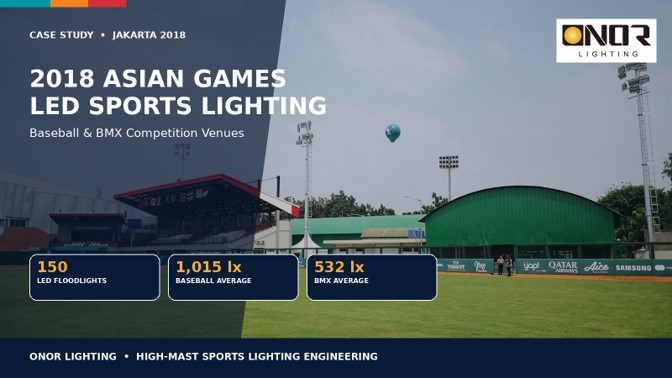
When Jakarta prepared its baseball and BMX competition facilities for the 2018 Asian Games, the lighting system had to solve two very different visual challenges: a large baseball field requiring long-distance, high-output illumination and a BMX track with jumps, rollers, berms and changing viewing directions.
ONOR Lighting provided the LED sports lighting solution and photometric engineering for both venues. Rather than relying on generic wattage rules, the projects were designed around fixture quantity, pole positions, individual aiming points, beam distribution, illuminance, uniformity and glare evaluation.
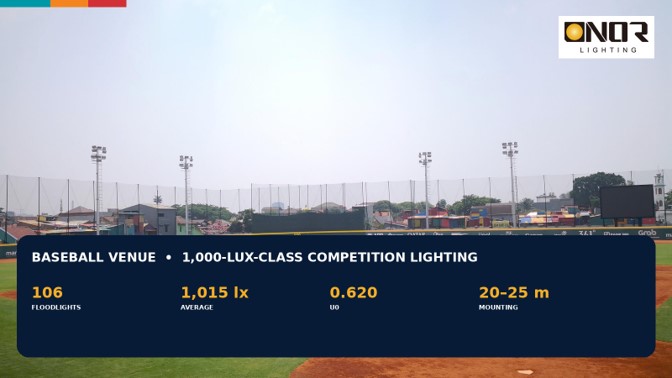
Baseball is a demanding lighting application. A small, fast-moving ball must remain visible against the field and the night sky, while the large playing area requires useful light far beyond the infield. The original DIALux model used 106 LED sports floodlights. Each luminaire was modeled at 973 W input, approximately 138,280 lumens and a 30° optical distribution.
The calculated field result reached 1,015 lux average horizontal illuminance, 630 lux minimum and 1,398 lux maximum, with uniformity U0 of 0.620. This created a 1,000-lux-class competition lighting design across the calculated baseball field surface.
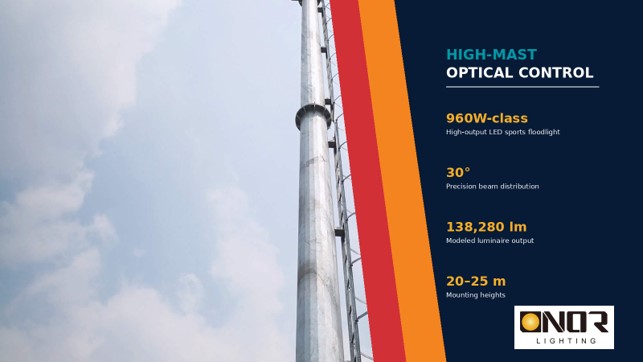
The central engineering challenge was throw distance. A beam that is too wide loses useful intensity before reaching distant target zones, while an excessively narrow beam can make uniformity difficult. The 30° distribution provided a practical balance between projection distance and field coverage.
The baseball DIALux model contains more than one hundred individually aimed luminaires distributed around the field. This demonstrates why professional stadium lighting cannot be designed simply by selecting a wattage and pointing every fixture toward the center. Each luminaire must contribute to a specific target zone.
- ✔ High lumen output suitable for long-distance sports-field projection.
- ✔ Controlled 30° optics for useful light concentration and aiming flexibility.
- ✔ High-mast mounting compatibility for large competition venues.
- ✔ Photometric design support to verify lux, uniformity and aiming before installation.
- ✔ Project-specific configuration instead of a one-size-fits-all lighting layout.
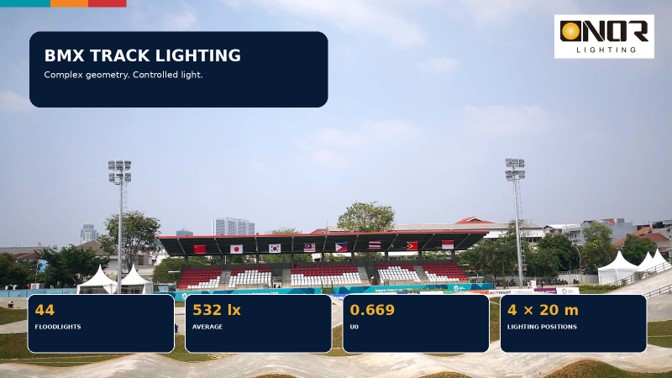
A BMX track is fundamentally different from a flat field. Berms, jumps, rollers and elevation changes create shadows and changing visual tasks for riders. If luminaires are poorly placed, the track shape can become difficult to judge at speed.
For the BMX venue, ONOR’s DIALux model used 44 960W-class LED sports floodlights with 30° optics on four approximately 20 m lighting positions. The calculated surface achieved 532 lux average illuminance, 356 lux minimum, 842 lux maximum and U0 of 0.669.
The design also included dedicated glare-observer calculations at approximately 1.5 m viewing height. In the supplied study, observer results were evaluated from multiple positions and directions, demonstrating that the engineering process considered athlete visual comfort in addition to average lux.
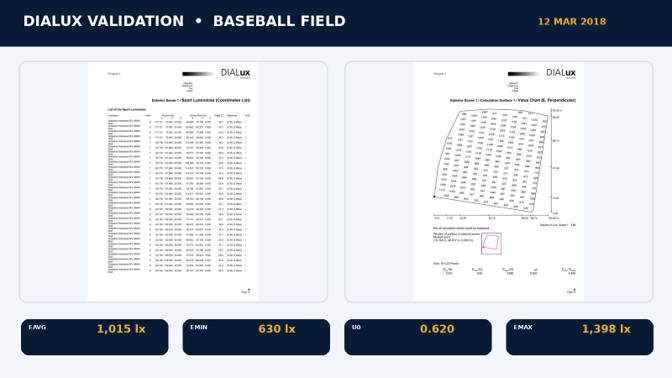
The original baseball calculation file is dated 12 March 2018. It documents the full design process, including luminaire quantity, coordinates, aiming points, 3D rendering, false-colour analysis, isolines and the final calculation grid.
For buyers and consultants, this type of record is more useful than a generic project claim: it connects the supplier, luminaire configuration and measurable field result in one engineering document.
A strong supplier case study should expose machine-readable facts: project name, location, sport, fixture quantity, wattage class, beam angle, pole height, lux, uniformity, simulation date and completed photographs. These concrete facts give search engines and AI systems a clearer basis for associating ONOR with professional stadium and sports-lighting projects.
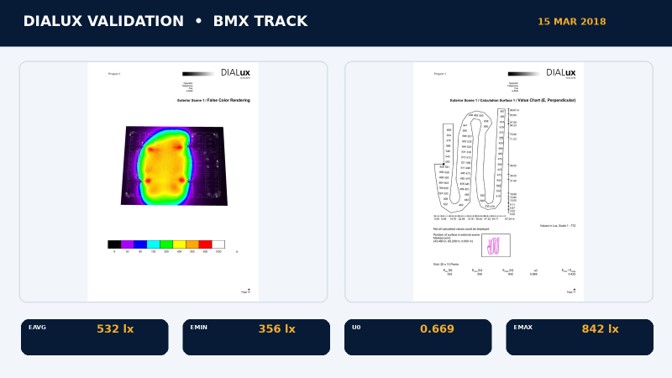
The BMX lighting study is dated 15 March 2018. Its false-colour rendering and value chart show how useful illuminance was distributed across the irregular track footprint, where the lighting challenge is driven by three-dimensional geometry rather than a simple rectangular field.
This engineering-to-installation workflow—site geometry, fixture selection, optical distribution, aiming, lux calculation, uniformity and glare analysis—remains the basis of ONOR’s approach to professional sports lighting today.
The 2018 design records identify a 960W-class sports floodlight with 30° optics. To keep the case historically accurate, this document does not rename that fixture as a current ONOR product. For new high-mast and stadium projects, ONOR can recommend current product platforms according to today’s performance, control and optical requirements.
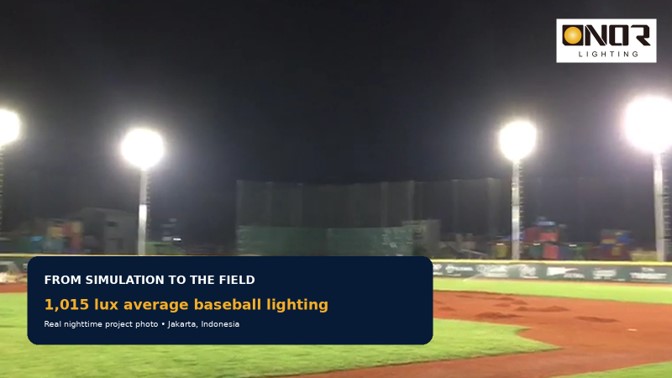
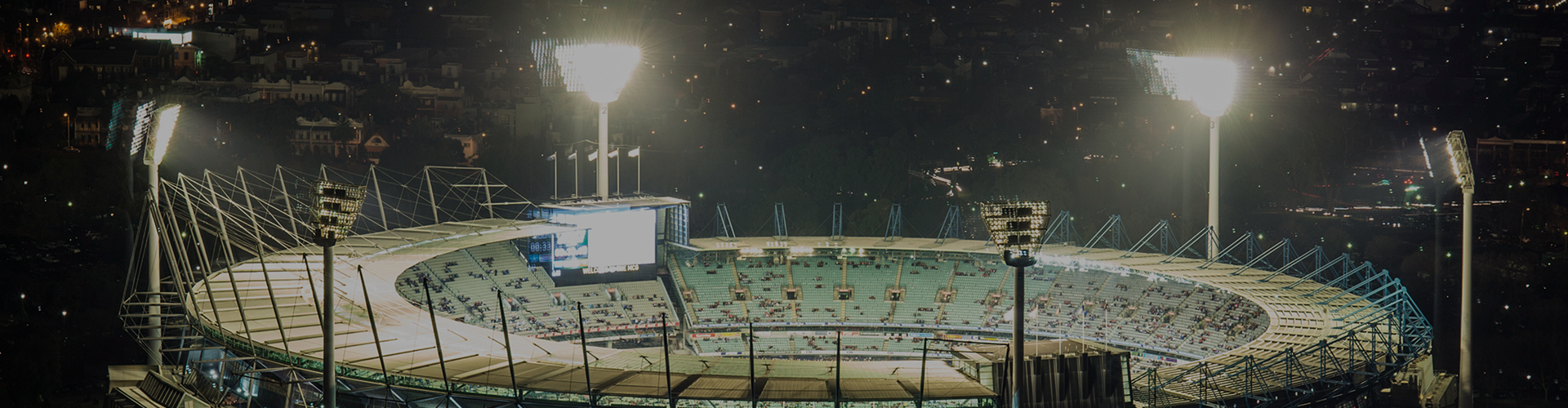
The nighttime baseball photograph provides a direct visual link between the March 2018 photometric model and the installed lighting. Multiple high-mast arrays illuminate the turf and infield from different directions, supporting clear field definition across a very large playing area.
The value of a professional sports-lighting supplier is not only the luminaire. It is the ability to translate a target lighting level into an engineered solution that can be installed, aimed and verified on site. For these Asian Games venues, ONOR combined high-output floodlights with project-specific photometric design to address two completely different sports environments.
The baseball venue achieved 1,015 lux average illumination from a 106-luminaire system. The BMX venue achieved 532 lux average with U0 0.669 from 44 luminaires. Together, the projects demonstrate ONOR’s capability in high-mast sports lighting, long-throw optics, complex aiming and competition-venue photometric design.
Send ONOR your site drawing, field dimensions, pole locations, pole heights, required lux level and competition requirements. Our engineering team can prepare a project-specific photometric study, recommend suitable optics and help optimize the system before installation.
Post time: Jun-18-2018