
O'Dempsey's GAA Pitch LED Floodlighting Project in Ireland
369 Lux Average · U0 0.82 · 18m Poles · Lightwing 600W–1200W LED Sports Floodlights
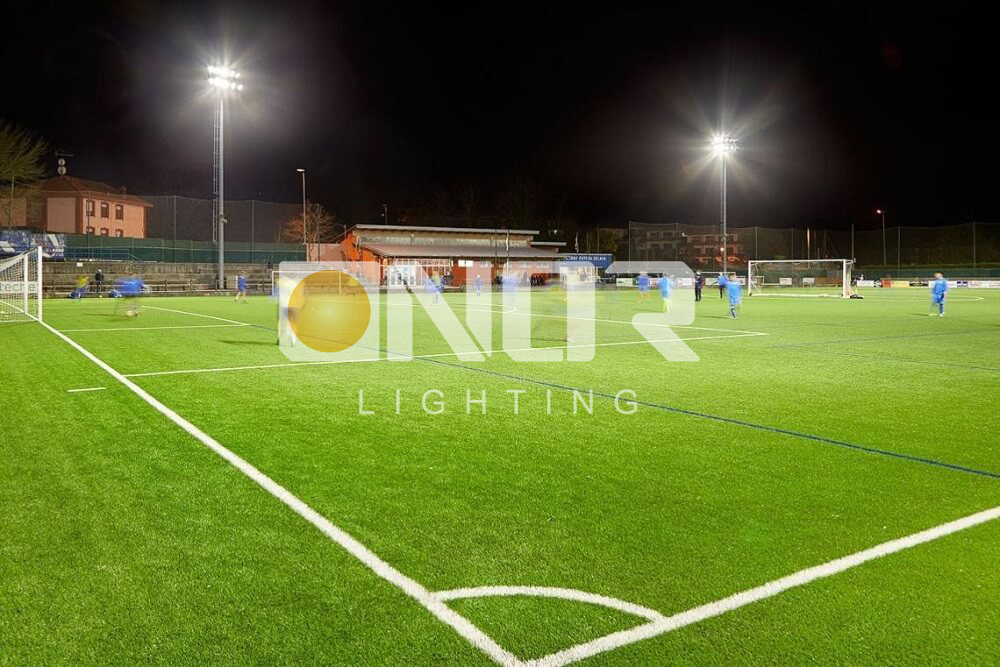
For Gaelic football clubs, good floodlighting is not simply about making the pitch brighter.
Players need to follow a fast-moving ball over long distances, judge high passes against the night sky and maintain clear visibility while moving between different areas of a large playing surface. For this reason, illuminance, uniformity, glare control and optical distribution all need to be considered together.
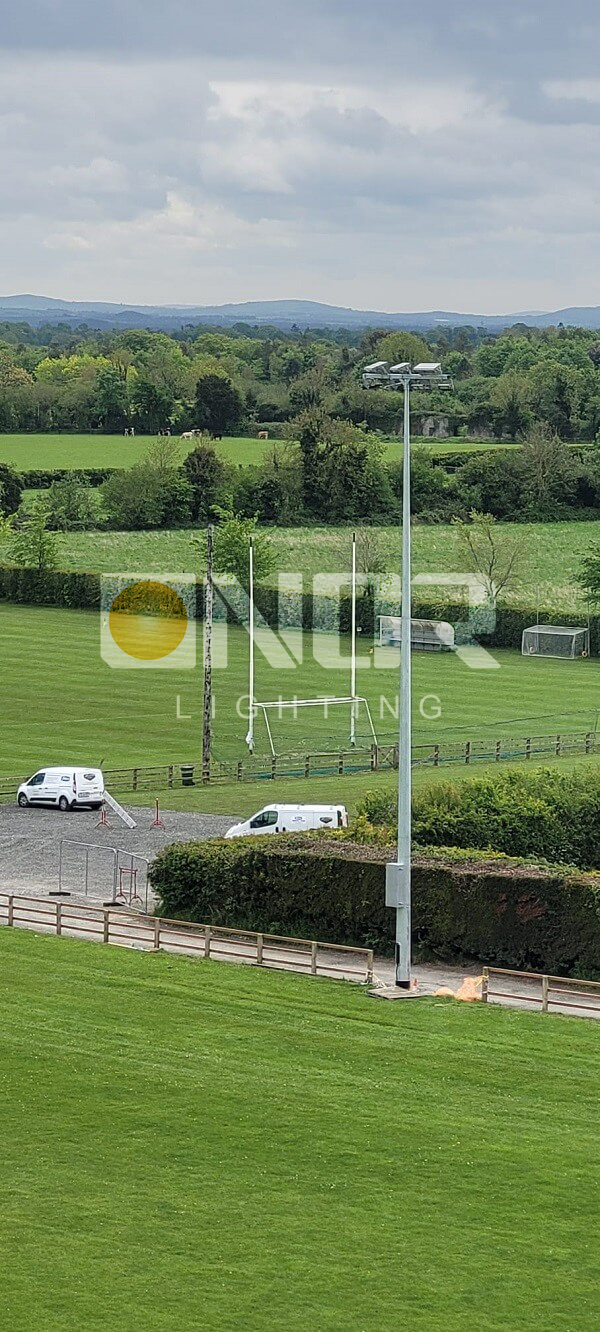
ONOR Lighting provided the sports lighting solution for O'Dempsey's GAA, a Gaelic football club in County Laois, Ireland. The club is recognised by Laois GAA as O'Dempsey's / O Diomasaigh. Laois GAA
The project involved a 130 × 80 metre GAA pitch, with luminaires installed on 18-metre lighting poles. The design requirement was approximately 350 lux average illuminance with a target uniformity of U0 0.60. New Again
Following detailed DIALux simulation and fixture aiming optimisation, the main playing-area calculation achieved:
369 lux average illuminance
302 lux minimum illuminance
512 lux maximum illuminance
U0 = 0.82
These results significantly exceeded the original uniformity target while also surpassing the required average illuminance. New Again
Project at a Glance
| Project | Details |
|---|---|
| Project | O'Dempsey's GAA Pitch Floodlighting |
| Location | County Laois, Ireland |
| Application | Gaelic football / GAA pitch lighting |
| Field Size | 130 × 80 m |
| Pole Height | 18 m |
| Lighting Product | ONOR Lightwing LED Sports Floodlights |
| Power Range Used in Design | 600W / 800W / 1200W |
| Design Target | 350 lux / U0 0.60 |
| Final PA Average | 369 lux |
| Minimum Illuminance | 302 lux |
| Uniformity U0 | 0.82 |
| Maintenance Factor | 0.80 |
| ULR in Simulation | 4.0% |
| Completed | June 2022 |
The project page records completion in June 2022, while the engineering simulation itself was prepared in November 2021. ONOR New Again
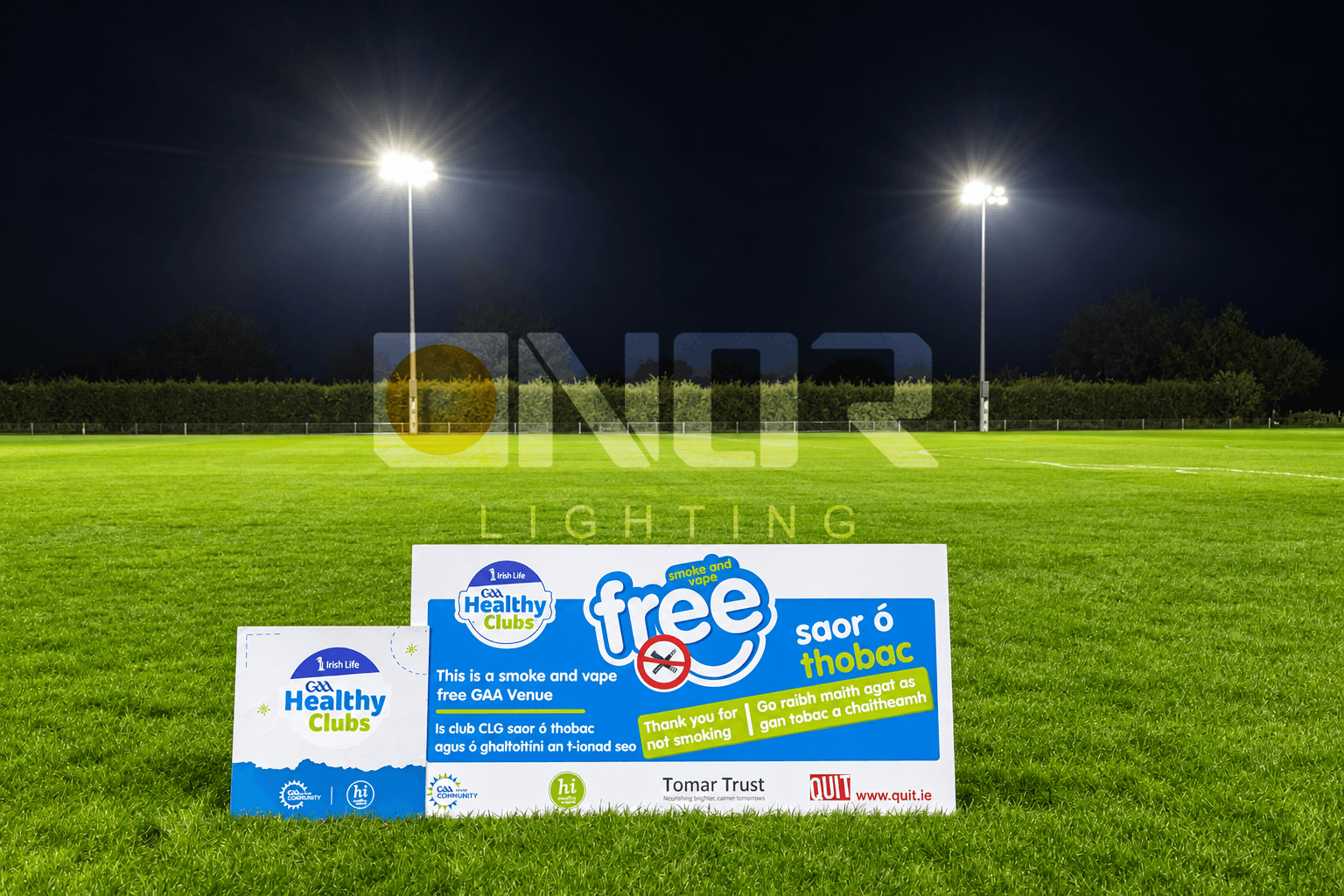
The Challenge: Lighting a Large GAA Pitch Uniformly
A Gaelic football pitch presents a different challenge from a small-sided football or training field.
At approximately 130 metres long and 80 metres wide, the O'Dempsey's pitch requires substantial throw distances from the lighting poles to the centre and opposite areas of the field.
Simply installing powerful floodlights would not guarantee good lighting quality.
If the beam angles are too narrow, the system can create excessive bright spots.
If they are too wide, too much useful light may be lost before reaching distant areas.
If all luminaires use the same optical distribution, it becomes difficult to achieve strong uniformity across such a large pitch.
For this reason, ONOR's design used several different Lightwing optical configurations rather than one generic floodlight arrangement.
A Multi-Optic Lightwing Solution
The DIALux design combines 600W, 800W and 1200W luminaires with several beam distributions.
The luminaire schedule includes:
- Lightwing 600W with 10° optics
- Lightwing 600W with 30° optics
- Lightwing 800W with 10° optics
- Lightwing 800W with 30° optics
- Lightwing 1200W with 30° optics
- Lightwing 1200W with 60° optics
- 1200W asymmetric P45 30° × 110° distribution
The original design schedule therefore does much more than simply specify "800W and 1200W floodlights." New Again New Again
Each optical distribution performs a different job.
10° narrow beams provide long-distance projection.
30° beams cover intermediate areas.
60° optics provide broader illumination where shorter throw distances are required.
The asymmetric distribution helps place light more precisely into specific zones while limiting unnecessary light outside the intended area.
This is one of the main reasons project-specific photometric design is more effective than selecting sports floodlights by wattage alone.
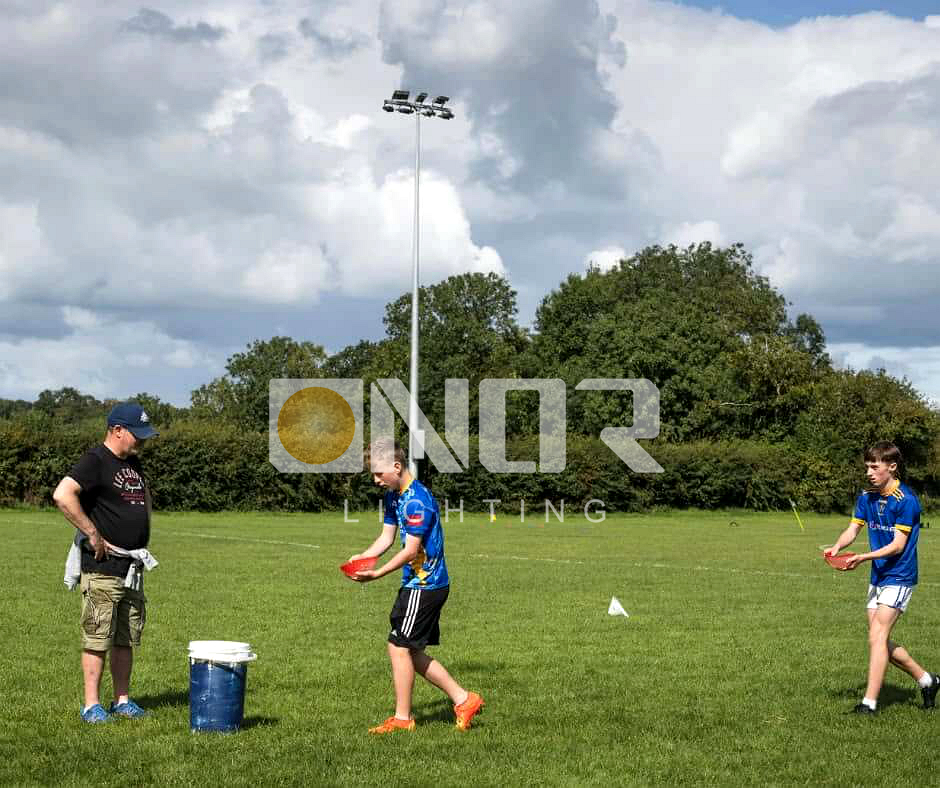
Six 18-Metre Lighting Positions
The DIALux model uses six pole positions distributed along the two long sides of the pitch.
Four poles are positioned toward the corners, with another two located around the centre line. The pole layout allows illumination to overlap from several directions rather than relying on a small number of highly concentrated beams. New Again New Again
All sports luminaires in the design are mounted at approximately 18 metres.
This height provides the throw distance needed for the large GAA pitch while allowing the lighting designer to distribute light across the playing surface using different aiming angles.
369 Lux Is Good — U0 0.82 Is Even More Important
Average lux is usually the first number customers ask about.
But in practical sports lighting, uniformity can be just as important as illuminance.
Imagine two pitches that both achieve an average of 350 lux.
One varies between very dark and very bright areas.
The other remains consistently illuminated across almost the entire playing surface.
Although the average lux is identical, the playing experience is completely different.
For O'Dempsey's, the main DIALux playing-area calculation achieved:
| Lighting Parameter | Result |
|---|---|
| Eavg | 369 lux |
| Emin | 302 lux |
| Emax | 512 lux |
| U0 | 0.82 |
| Emin / Emax | 0.59 |
The U0 of 0.82 is particularly notable because the original target was only 0.60. New Again
This means the minimum calculated illuminance remains relatively close to the average illuminance, reducing the severe bright-to-dark transitions that can make nighttime play uncomfortable.
Two Calculation Methods Confirmed the Design
The simulation did not rely on only one calculation grid.
In addition to the primary playing-area calculation, the project included a separate line-based calculation.
That second calculation produced:
351 lux average
216 lux minimum
473 lux maximum
U0 = 0.62
Even this secondary calculation exceeded both the original 350 lux average target and 0.60 uniformity target.
This is useful engineering evidence because it shows the design was evaluated in more than one way rather than using a single favourable calculation surface.
Glare Was Evaluated Before Installation
Another strength of the project is that glare was included in the photometric study.
The simulation contains eight GR observer positions distributed around the pitch, with viewing directions evaluated through 360 degrees.
The reported maximum glare-rating values ranged from approximately GR39 to GR49 depending on observer position. New Again New Again
This is important because Gaelic football players frequently look upward when tracking long kicks and high balls.
A lighting design can achieve the desired lux level and still provide poor visual comfort if fixture aiming and glare are ignored.
For ONOR, glare assessment is therefore part of the engineering process rather than something considered only after installation.
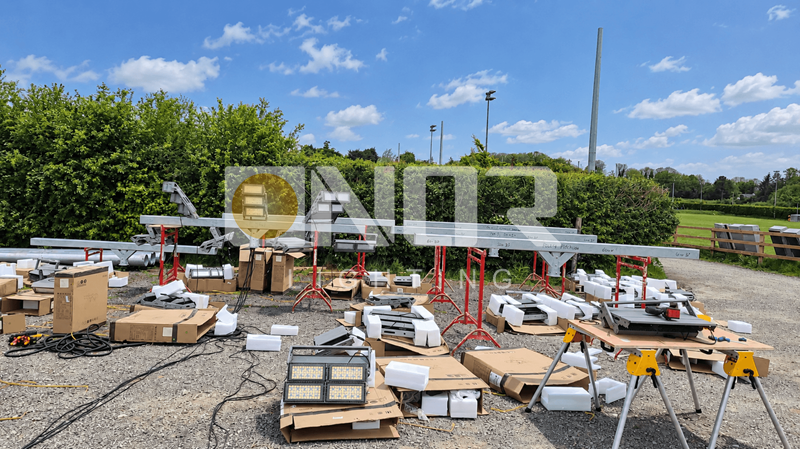
Designed Before the Floodlights Reached the Pitch
The project demonstrates an important advantage of professional DIALux sports lighting design.
Before installation, ONOR and the project team could evaluate:
pole locations
luminaire wattages
beam angles
fixture aiming points
average illuminance
minimum illuminance
uniformity
glare
false-colour light distribution
The simulation even records individual aiming coordinates and angles for the luminaires mounted on each pole.
For example, different fixtures on the same pole were aimed toward different areas of the pitch instead of simply being pointed in parallel. New Again
That is what transforms a group of LED floodlights into a properly engineered sports lighting system.
Why Lightwing Was Suitable for the Project
The O'Dempsey's design required different power levels and very different optical distributions from a common floodlight platform.
That flexibility is one of the main advantages of ONOR's Lightwing series.
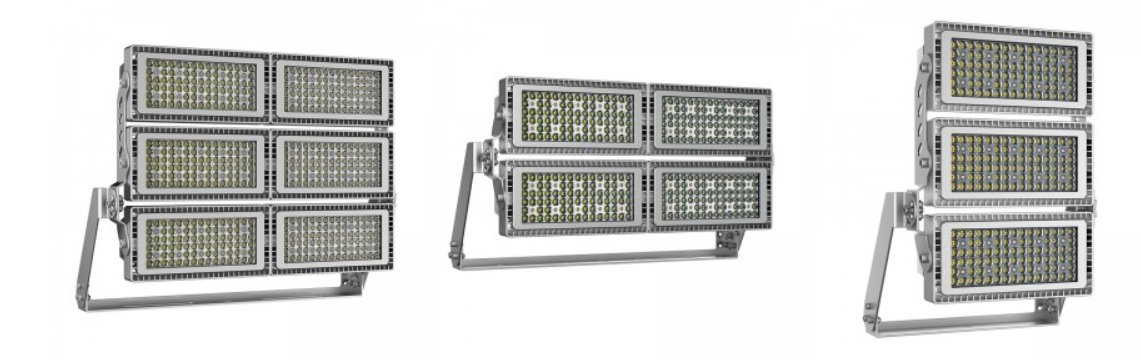
The current Lightwing platform is available from 200W to 1600W and offers multiple symmetric and asymmetric optics, including 10°, 30°, 60°, 90°, 80 × 150°, P45 30 × 110° and P60 30 × 90°. Current specifications also list up to 160 lm/W efficacy, IP67 protection, 20kV surge protection and optional DALI, DMX and wireless control. ONOR
For a large pitch such as O'Dempsey's, the key benefit is not simply high output.
It is the ability to combine different wattages and different optics within one engineered lighting system.
Built for Ireland's Outdoor Conditions
Outdoor sports lighting in Ireland operates through rain, humidity, wind and significant seasonal temperature changes.
Sports floodlights mounted 18 metres above the ground are also not equipment that a club wants to service frequently.
The current Lightwing platform therefore uses an IP67-rated construction, corrosion-resistant hardware and a design intended for long-term outdoor operation. ONOR
For clubs and contractors, reliability at height can be just as important as initial lighting performance because every future maintenance intervention involves access equipment, labour and potential disruption to the pitch.
From a 350 Lux Target to 369 Lux with U0 0.82
The strongest part of this project is that its performance can be expressed in measurable engineering terms.
The brief called for:
350 lux average illuminance
U0 ≥ 0.60
The final primary playing-area simulation achieved:
369 lux average illuminance
302 lux minimum illuminance
U0 = 0.82
Instead of simply claiming that the pitch is "bright" or "well illuminated," these results provide contractors, consultants and future customers with quantitative evidence of the lighting design.
That is exactly how ONOR approaches professional sports lighting:
define the target → model the field → select the optics → aim every luminaire → calculate performance → install according to the engineered design.
A Reference Project for GAA and Gaelic Football Lighting
The O'Dempsey's project is a useful reference for other GAA clubs planning a new floodlighting system or replacing older HID and metal-halide installations.
Large Gaelic football pitches require careful engineering because of their size and the long throw distances involved.
A successful solution should consider much more than the nominal wattage of the floodlight.
It should answer practical questions such as:
Can the required lux level be achieved?
How uniform is the lighting?
What happens at the centre of the pitch?
Which optics should be used from each pole?
Where should each luminaire be aimed?
What glare will players experience?
Can the system be maintained reliably over its operating life?
The O'Dempsey's design demonstrates how these questions can be addressed before installation using photometric simulation and a flexible LED sports lighting platform.

FAQ
How many lux does the O'Dempsey's GAA pitch have?
The primary DIALux playing-area calculation achieved 369 lux average illuminance, with 302 lux minimum and 512 lux maximum illuminance. New Again
What uniformity was achieved?
The primary playing-area calculation achieved U0 0.82, compared with the original project target of U0 0.60.
What size is the GAA pitch?
The project design uses a field size of approximately 130 × 80 metres. New Again
How high are the lighting poles?
The luminaires were designed around 18-metre mounting heights. New Again
Which LED floodlights were used?
The lighting design uses ONOR Lightwing 600W, 800W and 1200W sports floodlights, together with multiple narrow, medium, wide and asymmetric optical distributions.
Does ONOR provide DIALux design for GAA pitches?
Yes. ONOR can provide photometric simulation, optical selection, fixture aiming, IES files and project-specific lighting layouts for Gaelic football pitches and other outdoor sports facilities.
CTA
Planning a GAA Pitch Floodlighting Project?
Send ONOR your:
pitch dimensions · pole positions · pole heights · target lux level · site drawings · existing lighting information
Our engineering team can evaluate the project and prepare a suitable LED GAA pitch lighting design, DIALux simulation and floodlight configuration.
Request a Free Sports Lighting Design →
Post time: Jun-28-2022