
Professional LED Tennis Court Lighting for Six Courts in Austria
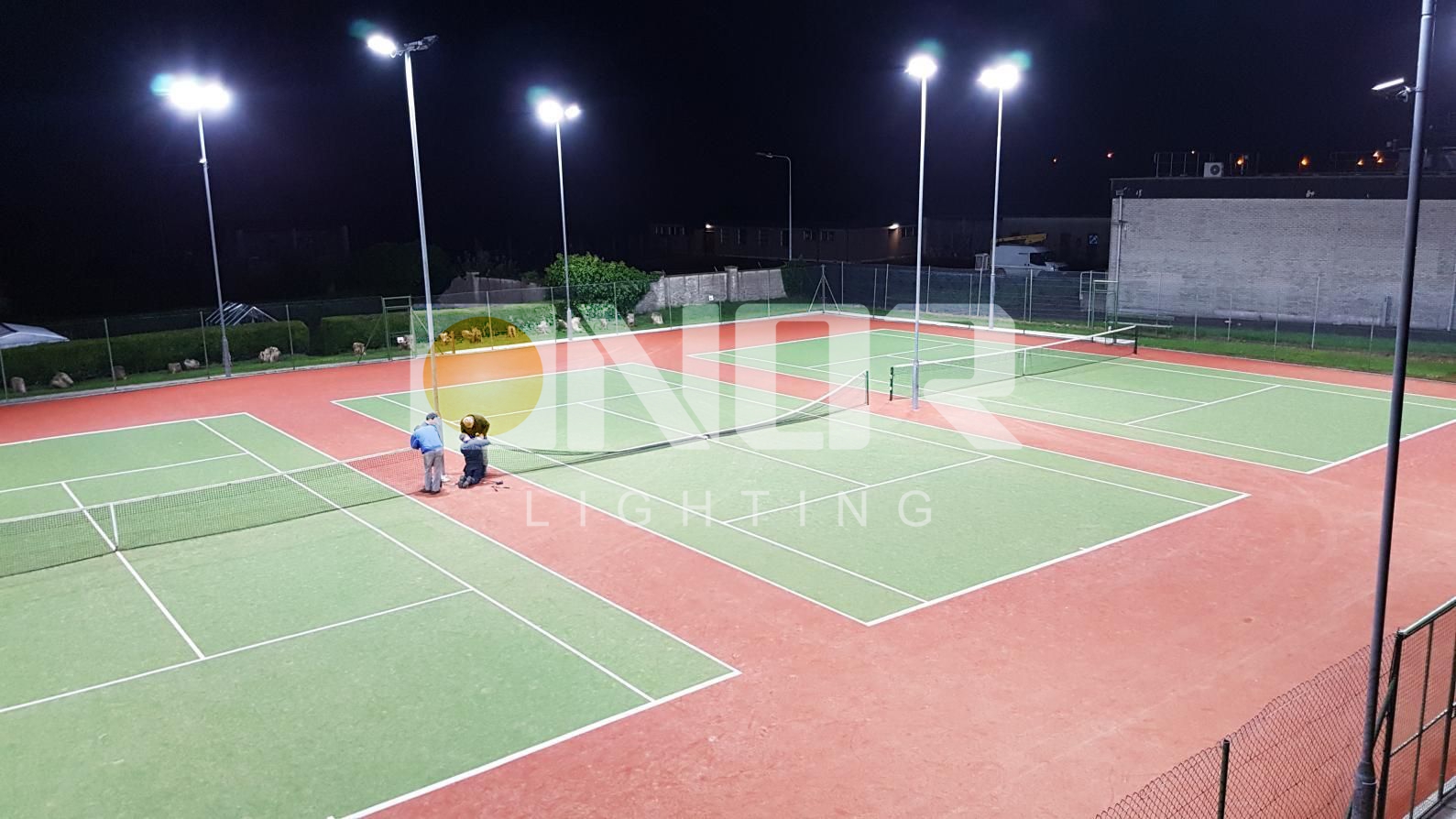
ONOR Lighting completed a professional outdoor tennis lighting project in Austria, providing a coordinated LED floodlighting solution for six tennis courts.
The project uses 36 × 400W Lightwing LED sports floodlights, with a total nominal installed lighting power of approximately 14.4 kW.
The finished lighting system achieved:
350 lux average illuminance
U0 = 0.86 uniformity
The project was completed on 7 July 2022. These figures are recorded on ONOR's original project page. ONOR
For a multi-court tennis facility, the high uniformity is particularly important. Rather than creating isolated bright areas around each floodlight, the lighting design distributes illumination consistently across the playing surfaces, helping players maintain clear visibility as the ball travels at high speed from one side of the court to the other.
Project at a Glance
| Project | Details |
|---|---|
| Application | Outdoor tennis court lighting |
| Location | Austria |
| Number of Courts | 6 |
| Product | ONOR Lightwing LED Sports Floodlight |
| Fixture Power | 400W |
| Quantity | 36 units |
| Nominal Installed Power | 14.4 kW |
| Average Illuminance | 350 lux |
| Uniformity | U0 0.86 |
| Optical Concept | Asymmetric light distribution |
| Spill-Light Control | Dedicated visor / shielding |
| Completion Date | 7 July 2022 |
Why Tennis Lighting Requires More Than High Lux
Tennis is one of the sports where lighting quality can immediately affect the player's visual experience.
The ball is relatively small, moves quickly and frequently changes direction. Players also look both horizontally across the court and upward while serving or tracking a lob.
This means a successful tennis lighting system needs more than sufficient brightness.
It needs to balance:
horizontal illuminance
uniformity
glare control
beam direction
spill-light control
A court may technically reach the required lux level but still feel uncomfortable if some areas are excessively bright while others are significantly darker.
That is why the U0 0.86 result is one of the strongest features of this Austrian project.
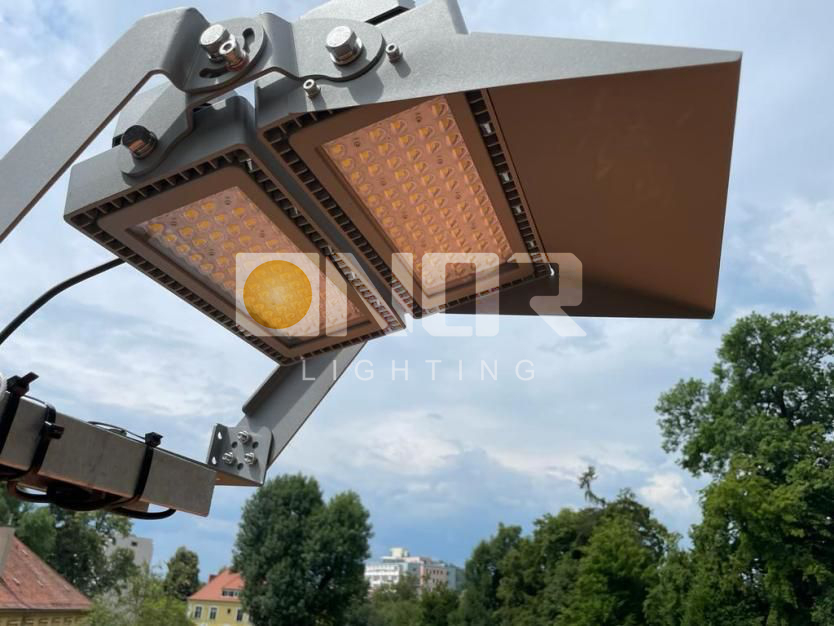
350 Lux with U0 0.86 Uniformity
Average illuminance tells us how much light reaches the playing surface overall.
Uniformity tells us how consistently that light is distributed.
For this six-court facility, the finished design achieved approximately:
Eavg: 350 lux
U0: 0.86
A U0 value of 0.86 indicates a highly consistent lighting distribution across the calculated playing area.
For players, this helps reduce abrupt changes in perceived brightness when following the ball between the baseline, service boxes and net area.
For club operators, good uniformity also means that useful light is being distributed effectively rather than simply creating excessively bright spots beneath individual luminaires.
Asymmetric Optics for Better Court Control
One of the key elements of this project was the use of asymmetric light distribution.
Unlike a simple symmetrical floodlight that spreads light broadly in several directions, an asymmetric sports floodlight is designed to project more usable light forward onto the target playing area.
For tennis courts, this can be particularly valuable because luminaires are generally installed outside the court boundary.
The objective is to illuminate the playing surface without directing unnecessary light behind the pole or into surrounding areas.
ONOR therefore combined the Lightwing floodlights with dedicated visor-based shielding to improve optical control and reduce unwanted spill light around the courts. The original project page specifically identifies the asymmetric optical concept and special visor as part of the installation. ONOR
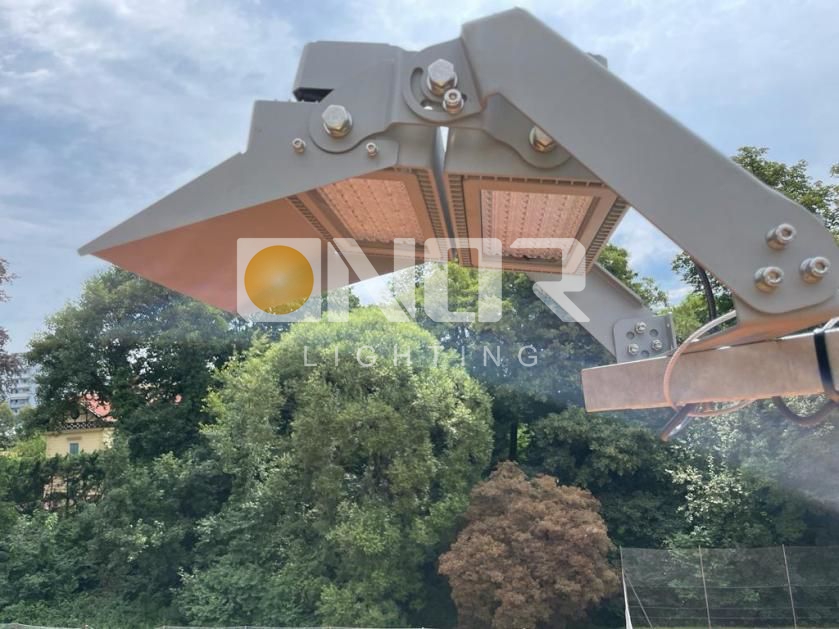
Controlling Spill Light Around a Six-Court Facility
Spill light becomes increasingly important when several tennis courts are located together.
With six courts operating simultaneously, poorly controlled floodlights can send significant amounts of light beyond the playing area.
This may affect:
nearby properties, pathways, trees, neighbouring sports facilities and the night-time environment around the club.
The aim of the Austrian project was therefore not simply to generate more lumens.
It was to place useful light on the tennis courts while limiting unnecessary light outside them.
That required an appropriate combination of:
asymmetric optics
fixture aiming
visor design
luminaire positioning
This approach is more effective than solving the problem only by reducing wattage or tilting conventional floodlights steeply downward.
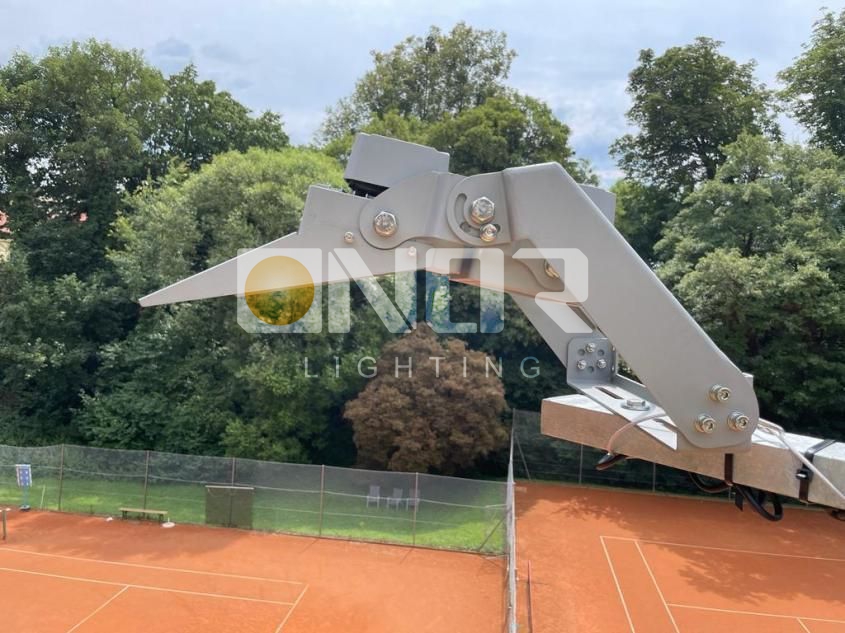
36 lightwing 400W Floodlights Across Six Courts
The complete project uses 36 lightwing 400W LED floodlights. ONOR
Using a coordinated luminaire platform across the six courts simplifies both the original lighting design and future maintenance.
More importantly, the Lightwing platform allows different optical configurations to be selected according to application requirements.
ONOR's current Lightwing range offers symmetric and asymmetric distributions including 10°, 30°, 60°, 90°, 80 × 150°, asymmetric P45 30 × 110° and P60 30 × 90° optics. ONOR
This optical flexibility is particularly useful for multi-court tennis facilities, where luminaires installed along outer boundaries and between adjacent courts may perform different lighting tasks.
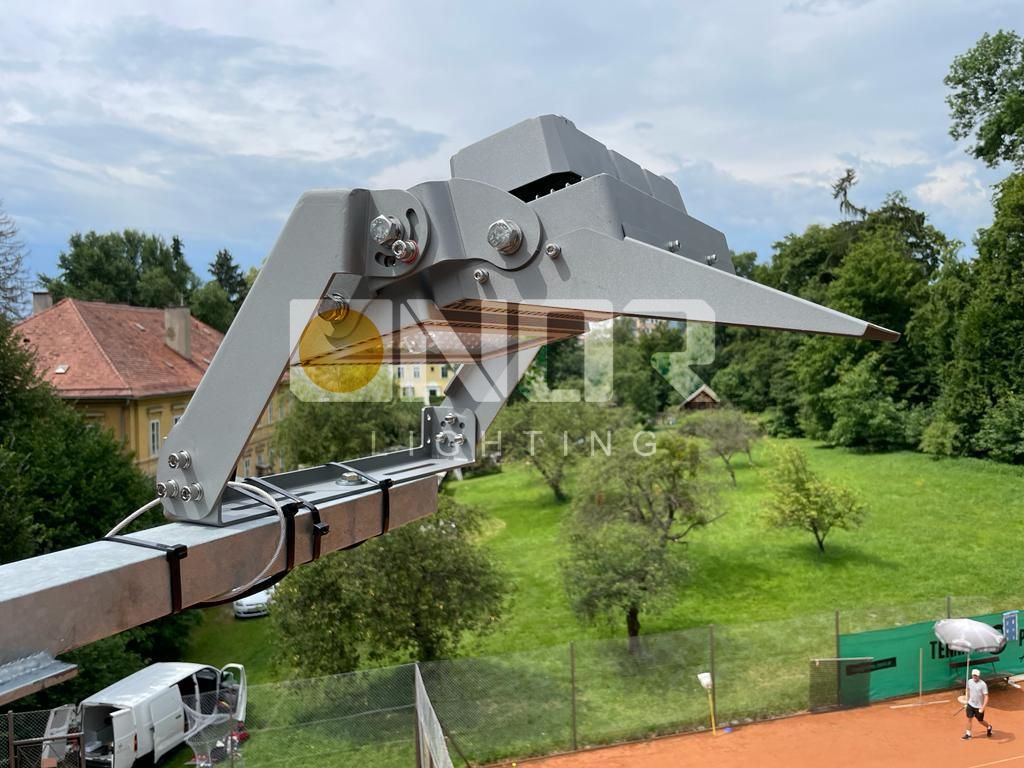
Why Lightwing Works Well for Tennis Facilities
For an outdoor tennis club, luminaire performance is not determined by lumen output alone.
The fixture also needs to offer:
accurate optical control
low glare characteristics
outdoor durability
reliable thermal management
easy aiming and installation
long service life
The current Lightwing platform is rated up to 160 lm/W, while the 400W version is specified at up to approximately 64,000 lumens. It is also listed with IP67 ingress protection, 20kV surge protection and an expected lifespan exceeding 100,000 hours. ONOR
The housing uses an aerodynamic design intended to reduce wind loading, which is also beneficial for outdoor sports installations mounted on lighting poles. ONOR
For long-term club operation, these mechanical and electrical characteristics matter because access equipment and labour can make maintenance at height considerably more expensive than servicing conventional indoor lighting.
Good Tennis Lighting Means Comfortable Visibility
For tennis players, comfortable lighting is especially important during:
serves
high lobs
fast baseline rallies
volleys at the net
movement between brightly and less brightly illuminated areas
Excessive glare can make the ball difficult to track when players look upward.
Poor uniformity creates repeated changes in visual adaptation.
Uncontrolled spill light wastes energy and can create problems outside the facility.
The Austrian six-court project therefore demonstrates why ONOR approaches tennis lighting as an optical engineering problem, rather than simply a wattage-selection exercise.
Lighting Designed Around the Courts
ONOR's tennis lighting approach starts with the geometry of the facility.
Before selecting the final luminaire configuration, the engineering process can evaluate:
court dimensions
number of courts
pole locations
mounting heights
target illuminance
uniformity requirements
neighbouring properties
possible glare directions
spill-light restrictions
A photometric model can then be used to determine fixture quantity, optical distribution and aiming.
This allows the customer to evaluate expected lighting performance before installation rather than trying to correct uneven lighting after the system has already been built.
From One Court to a Complete Tennis Complex
Lighting six courts is significantly different from lighting one isolated court.
Each court must perform well individually, but the facility must also work as one complete lighting system.
Adjacent luminaires should complement each other without creating:
excessive overlap, glare between courts, unnecessary energy use or unwanted light outside the venue.
The 350 lux / U0 0.86 result demonstrates how a coordinated lighting concept can provide both the required brightness and very strong uniformity across a multi-court facility.
A Reference Project for European Tennis Clubs
This Austrian project is a useful example for tennis clubs planning:
new outdoor courts, LED renovation projects, expansion of an existing tennis facility or replacement of older metal-halide floodlights.
Instead of selecting tennis floodlights only according to wattage, club owners and contractors should evaluate the complete lighting result.
Important questions include:
How many lux will the court achieve?
How uniform will the lighting be?
Will players experience uncomfortable glare?
How much light leaves the court?
Which optics are best for the available pole positions?
Can the floodlights be aimed accurately?
How difficult will future maintenance be?
A properly engineered photometric design can answer these questions before equipment is installed.
FAQ
How many LED floodlights were used for the six tennis courts?
The project uses 36 × 400W ONOR Lightwing LED sports floodlights. ONOR
What illuminance was achieved?
The project records an average illuminance of approximately 350 lux. ONOR
What uniformity was achieved?
The reported uniformity is U0 0.86, which is one of the strongest technical results of the project. ONOR
Why use asymmetric floodlights for tennis courts?
Asymmetric optics direct more useful light toward the playing surface while reducing unnecessary backlight and spill light behind the luminaire.
What wattage was used?
Each Lightwing floodlight used in this project is rated at 400W, giving a total nominal installed floodlight power of approximately 14.4 kW.
Can ONOR provide lighting design for multiple tennis courts?
Yes. ONOR provides project-specific photometric simulation, optical selection, fixture aiming and LED floodlight solutions for single courts and multi-court tennis facilities.
CTA
Planning a Tennis Court Lighting Project?
Send ONOR your:
court layout · number of courts · pole locations · pole heights · required lux level · site drawings or photographs
Our lighting engineers can prepare a project-specific tennis court lighting simulation and LED floodlight proposal, including suitable optical distributions and spill-light control.
Request a Free Tennis Lighting Design →
Post time: Jul-08-2022