

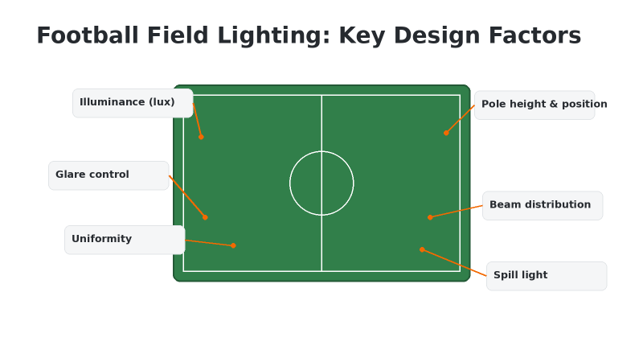
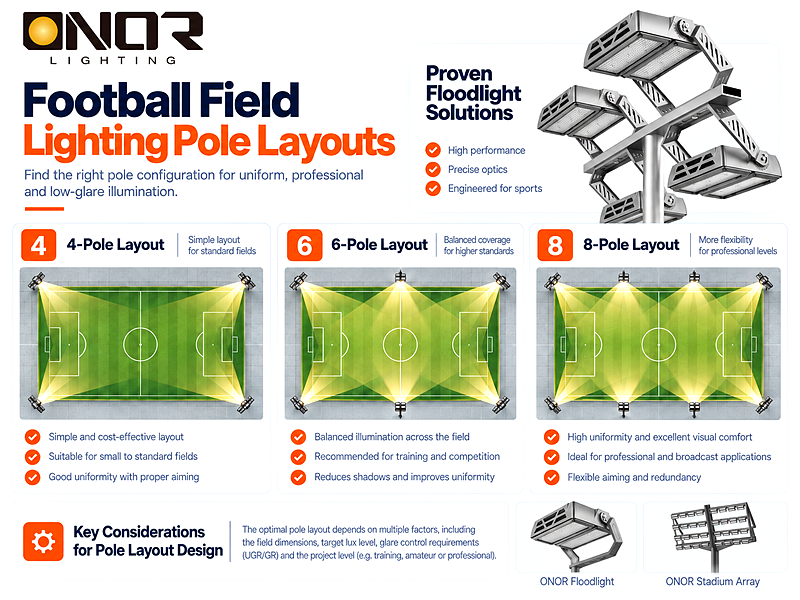
A simple summary graphic that can also be reused as a social-media or Google Images asset.
Designing football field lighting is not simply a matter of installing several powerful floodlights around a pitch. A good system needs to balance illuminance, uniformity, glare, vertical light, colour quality, light spill, pole geometry and energy consumption.
FIFA’s current stadium guidance similarly emphasizes adequate horizontal illuminance, uniform and comfortable light without glare, colour rendition, vertical illuminance for broadcast venues, and the reduction of unwanted lighting spill. The correct design target should always be matched to the level and use of the venue.
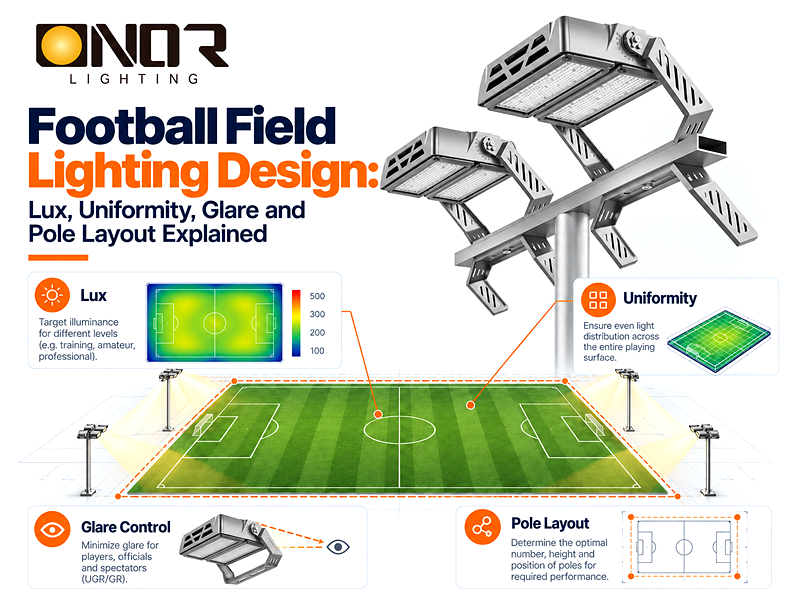
1. Illuminance: How Much Light Reaches the Field?
Illuminance is measured in lux (lx). Horizontal illuminance describes the amount of light reaching the playing surface. There is no single correct lux level for every football pitch: a community training field, competitive venue and professional broadcast stadium can have very different performance requirements.
- Type and level of competition
- Training, match or multi-use operation
- Governing standard or client specification
- Television and camera requirements
- Surrounding environmental constraints
For televised venues, vertical illuminance is also important because cameras need sufficient light on players from relevant viewing directions.
2. Uniformity Can Matter as Much as Average Lux
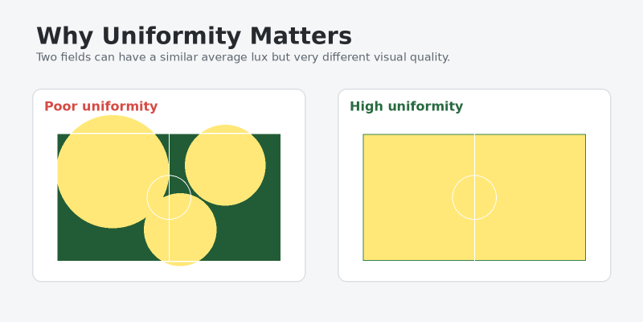
Two pitches can report a similar average lux value while looking completely different. If one pitch contains very bright and very dark areas, players and cameras must continually adapt as action moves around the field. Uniformity describes how evenly light is distributed across the measurement grid.
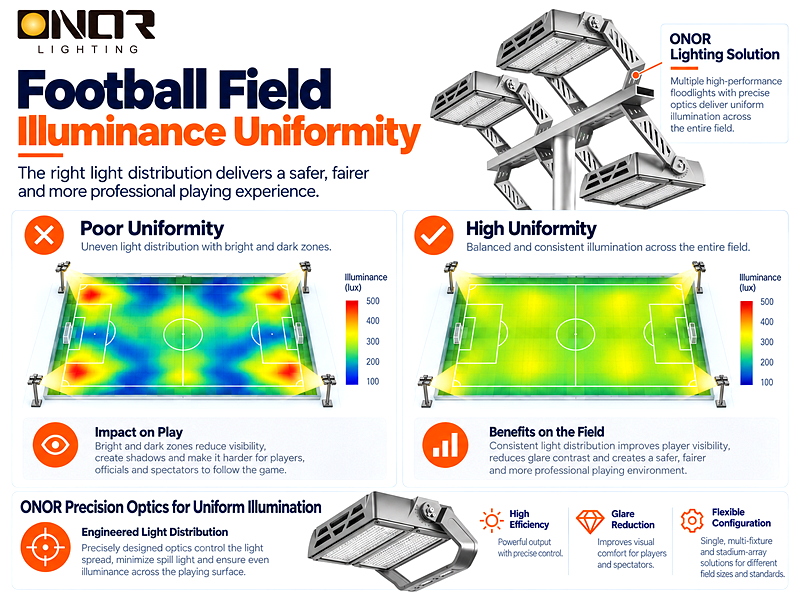
Illustrative comparison: similar average light can still produce very different visual quality if the distribution is uneven.
FIFA stadium guidance distinguishes uniformity measures based on minimum, maximum and average illuminance values. A project specification should therefore state both the target illuminance and the required uniformity ratio, not lux alone.
3. Glare Control
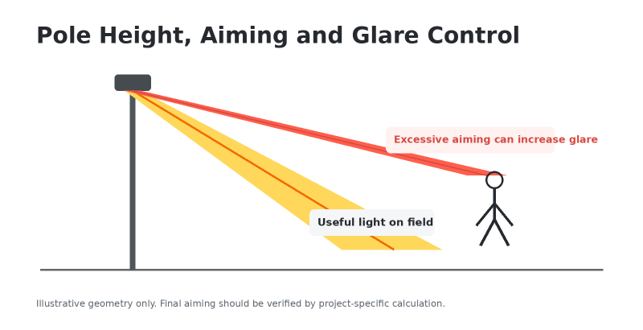
More light does not automatically mean better visibility. A powerful floodlight aimed into a player’s normal line of sight can create discomfort and make the ball harder to track. Glare is influenced by luminaire intensity, aiming direction, observer position, mounting height, beam distribution and the number of luminaires.
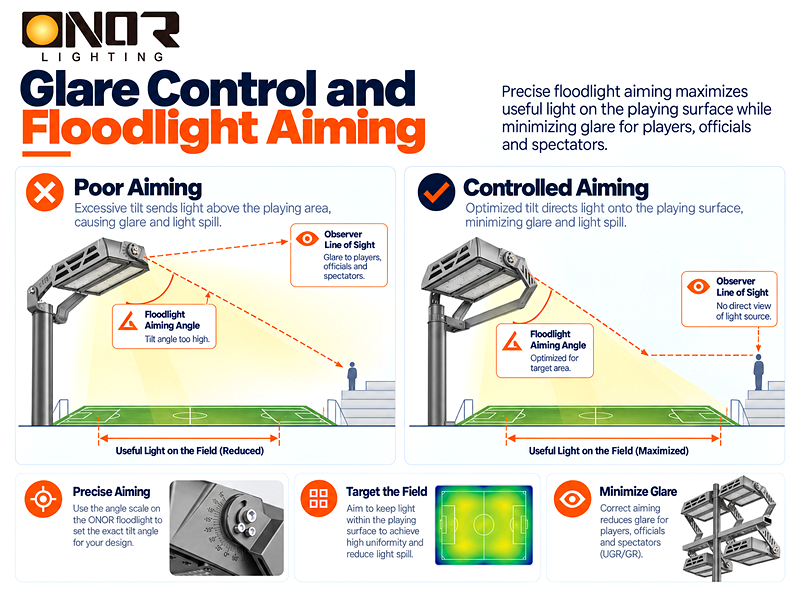
Illustrative geometry showing the difference between useful field light and an excessively high glare path.
Project-specific calculations and commissioning checks are therefore important. The luminaire and aiming plan should be developed together rather than treating aiming as an afterthought during installation.
4. Pole Height and Position
There is no universal “best” pole height for every football field. Pole configuration depends on the field dimensions, surrounding space, competition level, target performance, luminaire optics and glare limits. Higher mounting positions can improve certain aiming geometries, but they also increase throw distance. Lower positions may reduce structural requirements but can make glare control more difficult.
This is why pole design and photometric design should be coordinated from the beginning of a project.
5. Beam Angle and Optical Distribution
A stadium floodlight is not defined only by wattage. Two luminaires with the same power can create very different results if their optical distributions are different. A project may need a combination of narrow, medium, wide, symmetric or asymmetric distributions to illuminate near zones, central areas, sidelines and long-throw target areas efficiently.
6. Spill Light and the Surrounding Environment
Outdoor sports facilities increasingly need to consider neighbouring homes, roads and the night environment. Poorly controlled systems can illuminate façades, trees, roads or the sky instead of the playing surface. Good optical control aims to maximize useful light on the target area while reducing unnecessary light outside it.
7. Lighting for Television Broadcast
Broadcast stadiums introduce additional requirements because cameras experience lighting differently from the human eye. Depending on the event level and standard, design criteria can include vertical illuminance, colour rendering, correlated colour temperature, flicker performance, camera direction, modelling and uniformity. These requirements need to be considered early because they affect pole/roof geometry and luminaire aiming.
8. Why Photometric Simulation Should Come Before Purchasing Floodlights
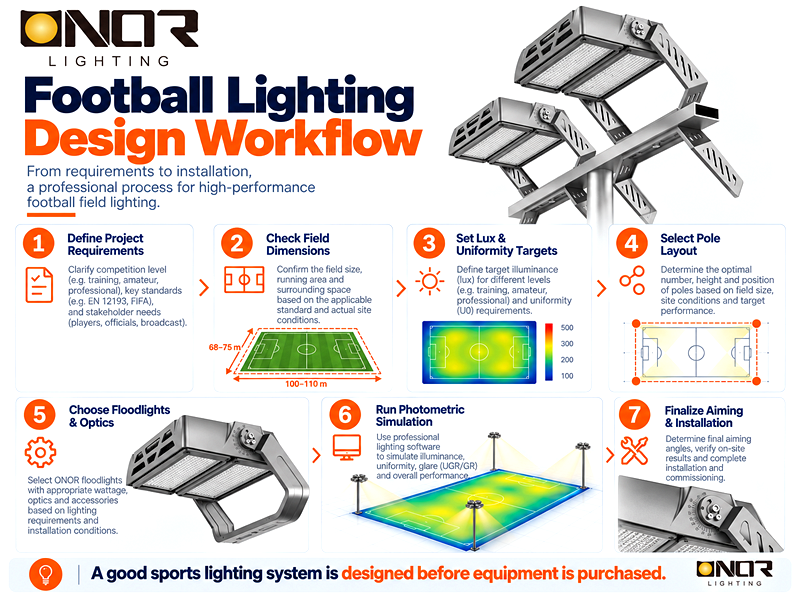
One of the most common mistakes in sports lighting is selecting fixtures based only on wattage, lumens and price. A more reliable workflow is:
- Define the required lighting performance.
- Model the pitch, surroundings and pole geometry.
- Select suitable optical distributions.
- Calculate the fixture quantity and installed power.
- Optimize aiming angles and positions.
- Review glare, uniformity and spill light.
- Finalize equipment and commissioning instructions.
This is why ONOR Lighting uses DIALux, Relux and AGi32 for project-specific calculations before the final luminaire configuration is confirmed.
Frequently Asked Questions
How many lux does a football field need?
It depends on the level of play, applicable standard and whether the venue is televised. The required lux value should be defined together with uniformity, glare and any broadcast criteria.
Is higher wattage always better?
No. Optical distribution, mounting height and aiming can matter as much as wattage. A higher-power fixture aimed poorly can increase glare and waste light.
What information is needed for a lighting calculation?
Field dimensions, pole positions and heights, target lighting criteria, drawings, surrounding constraints and—where relevant—broadcast requirements.
Why is uniformity important?
High uniformity reduces abrupt bright-to-dark transitions across the field, improving visual consistency for players, referees, spectators and cameras.
Can existing poles be reused in an LED retrofit?
Often yes, but the pole position, height, structural capacity and aiming geometry should be checked before the final fixture configuration is selected.
Need a Football Field Lighting Calculation?
Send ONOR Lighting the pitch dimensions, pole positions, pole heights, target lux level, project standard and available drawings. The engineering team can evaluate the project and prepare a photometric lighting proposal.
Reference Sources
FIFA Floodlights Standards: FIFA Quality Programme for Floodlights
FIFA Stadium Guidelines – Technical Systems and Services: Floodlighting guidance
Suggested Internal Links
Post time: Sep-29-2026